Learn › Year groups › Year 6
Year group guide
Year 6 maths: what your child learns (age 10 to 11)
Year 6 is for children aged 10 to 11, roughly the same as Grade 5 in the US. It's the last year of primary school and of Key Stage 2. In May, children take the Key Stage 2 SATs, and in September they move on to Year 7 at secondary school.
What Year 6 children are working on
Year 6 pulls together everything from primary maths and adds two new strands: ratio and proportion and algebra. Children learn long division, work fluently with fractions, decimals and percentages, find the area of triangles and the volume of cuboids, and calculate the mean.
Many schools spend part of the spring term revising for the SATs, which cover the whole of Key Stage 2 (Years 3 to 6). After the tests, many schools turn to projects and getting ready for secondary school.
The Year 6 maths curriculum
This follows the National Curriculum in England. Each heading links to a full guide to that topic.
Number and place value
- Read, write, order and compare numbers up to 10,000,000, and say what each digit is worth.
- Round any whole number to a given accuracy: 3,486,201 to the nearest 100,000 is 3,500,000.
- Use negative numbers in context and work out the gap across zero: from −4 °C to 6 °C is 10 degrees.
Addition and subtraction
- Do mental calculations with large numbers and mixed operations.
- Solve multi-step problems, choosing which operations and methods to use.
- Use estimation to check answers and decide how accurate an answer needs to be.
Multiplication and division
- Multiply numbers with up to four digits by a two-digit number using long multiplication: 1,342 × 23 = 30,866.
- Divide numbers with up to four digits by a two-digit number using long division (or short division where it works), and give remainders as a whole number, a fraction or a decimal, or by rounding, to suit the question: 432 ÷ 15 = 28 r 12, or 28⁴⁄₅, or 28.8.
- Find common factors, common multiples (12 and 24 are common multiples of 4 and 6) and prime numbers.
- Use the order of operations: multiplication and division come before addition and subtraction, so 3 + 4 × 2 = 11, not 14.
Fractions
- Simplify fractions using common factors: ¹²⁄₁₈ = ⅔ (divide the top and bottom by 6).
- Use common multiples to give fractions the same denominator, and compare and order fractions, including those bigger than 1.
- Add and subtract fractions with different denominators, and mixed numbers: ⅔ + ¼ = ⁸⁄₁₂ + ³⁄₁₂ = ¹¹⁄₁₂, and 2½ − 1⅓ = 2³⁄₆ − 1²⁄₆ = 1⅙.
- Multiply simple pairs of proper fractions, giving the answer in its simplest form: ¼ × ½ = ⅛.
- Divide a proper fraction by a whole number: ⅓ ÷ 2 = ⅙.
Decimals and percentages
- See a fraction as a division and find its decimal: ⅜ = 3 ÷ 8 = 0.375.
- Know the value of each digit in numbers with three decimal places, and multiply and divide by 10, 100 and 1,000: 4.5 ÷ 100 = 0.045.
- Multiply one-digit numbers with up to two decimal places by whole numbers: 0.36 × 7 = 2.52.
- Use written division where the answer has up to two decimal places: 9 ÷ 4 = 2.25.
- Round answers to a given number of decimal places.
- Recall and use equivalent fractions, decimals and percentages: ⅕ = 0.2 = 20%.
Ratio and proportion
- Solve problems about the relative sizes of two amounts: a recipe for 4 people uses 300 g of flour, so for 6 people you need 450 g (300 ÷ 4 = 75 g each, and 75 × 6 = 450).
- Find percentages of amounts and use them to compare: 15% of 360 is 54 (10% is 36 and 5% is 18).
- Solve problems with similar shapes and scale factors: a 3 cm by 5 cm rectangle enlarged by a scale factor of 2 is 6 cm by 10 cm.
- Solve unequal sharing problems: share 35 sweets in the ratio 2 : 3. There are 5 parts, each worth 7, so the shares are 14 and 21.
Algebra
- Use simple formulae: the perimeter of a rectangle is P = 2 × (l + w), so a 5 cm by 3 cm rectangle has P = 2 × 8 = 16 cm.
- Make and describe linear sequences: 3, 7, 11, 15… goes up by 4 each time, so the next number is 19.
- Write missing number problems with letters: n + 7 = 15, so n = 8.
- Find pairs of numbers that fit an equation with two unknowns, such as a + b = 10, and list all the possible combinations.
Measurement
- Convert between units of length, mass, volume and time, using decimals up to three places: 1.375 kg = 1,375 g.
- Convert between miles and kilometres: 5 miles is about 8 km.
- Know that shapes with the same area can have different perimeters: a 4 cm square and an 8 cm by 2 cm rectangle both have an area of 16 cm², but perimeters of 16 cm and 20 cm.
- Calculate the area of parallelograms (base × height) and triangles (½ × base × height): a triangle with a base of 6 cm and a height of 4 cm has an area of 12 cm².
- Calculate the volume of cubes and cuboids in cm³ and m³: a 5 cm × 4 cm × 3 cm box has a volume of 60 cm³.
Geometry: properties of shapes
- Draw 2D shapes with given lengths and angles, and build 3D shapes, including making nets.
- Find unknown angles in triangles (which add up to 180°), quadrilaterals (360°) and regular polygons: if two angles of a triangle are 50° and 60°, the third is 70°.
- Name the parts of a circle (radius, diameter and circumference) and know the diameter is twice the radius.
- Find missing angles at a point, on a straight line and where two lines cross (vertically opposite angles are equal).
Geometry: position and direction
- Use coordinates in all four quadrants, including negative numbers such as (−3, 2).
- Draw and translate shapes on a coordinate grid, and reflect them in the axes.
Statistics
- Read and draw pie charts and line graphs, and use them to solve problems.
- Calculate and understand the mean as an average: the mean of 4, 7, 9 and 12 is (4 + 7 + 9 + 12) ÷ 4 = 32 ÷ 4 = 8.
By the end of Year 6, most children can…
- read, write, order and round numbers up to 10,000,000
- use long multiplication and long division
- use the order of operations correctly
- simplify fractions, and add, subtract, multiply and divide them
- switch between fractions, decimals and percentages, such as ⅜ = 0.375 and ¾ = 75%
- find percentages of amounts, such as 15% of 360 = 54
- solve ratio and scaling problems, such as changing a recipe
- use simple formulae and solve equations such as n + 7 = 15
- find the area of triangles and parallelograms and the volume of cuboids
- find missing angles in triangles, quadrilaterals and on straight lines
- use coordinates in all four quadrants
- read pie charts and line graphs, and work out a mean
Key vocabulary
| Word | What it means |
|---|---|
| Long division | A written method for dividing by a two-digit number, writing out each subtraction step. |
| Order of operations | The rule for which part of a calculation to do first: brackets, then multiplying and dividing, then adding and subtracting. |
| Simplify | Write a fraction with the smallest possible numbers: ⁶⁄₈ = ¾. |
| Common denominator | The same bottom number, needed to add or subtract fractions. |
| Ratio | How much of one thing there is compared with another, written like 2 : 3. |
| Scale factor | How many times bigger (or smaller) a shape has been made. |
| Formula | A rule written with letters, such as P = 2 × (l + w). |
| Variable, unknown | A letter that stands for a number, such as n. |
| Radius, diameter, circumference | Centre to edge, edge to edge through the centre, and the distance all the way round a circle. |
| Vertically opposite angles | The angles opposite each other where two straight lines cross. They are always equal. |
| Mean | An average: add up all the values and divide by how many there are. |
The Key Stage 2 SATs
The Key Stage 2 SATs take place in May of Year 6. There are three maths papers:
| Paper | What it tests | Time |
|---|---|---|
| Paper 1: arithmetic | Calculations on their own, from 4,000 − 1,250 to long division and fractions. | 30 minutes |
| Paper 2: reasoning | Problem solving and using maths in context. | 40 minutes |
| Paper 3: reasoning | More problem solving and reasoning. | 40 minutes |
Calculators aren't allowed. Results are given as a scaled score from 80 to 120, and a score of 100 or more means your child has met the expected standard. Schools receive the results in July, and you'll hear them before the end of the summer term. The SATs also include reading and grammar, punctuation and spelling papers.
How to help at home
- A little arithmetic each day. Five calculations a day (a long multiplication, a fraction sum, a percentage) keeps methods fresh.
- Cook with ratio. Scale a recipe up or down: "This serves 4. How much do we need for 6?"
- Talk about prices. Sales, discounts and "best value" packs are real percentage and ratio problems.
- Ask for the method. When your child explains how they got an answer, they spot their own mistakes, and the reasoning papers reward clear thinking.
- Look at charts in the news. Pie charts and line graphs turn up everywhere. What do they show? Is anything misleading?
- Keep it calm. Sleep, breakfast and reassurance help more than late-night revision.
Encourage your child to write down their working in the reasoning papers, even when they can do some of it in their head. Some questions give a mark for a correct method even if the final answer is wrong, and written steps make slips easier to spot when checking.
Indie's challengeIndie makes a honey drink by mixing honey and water in the ratio 1 : 3. She uses 150 ml of honey. How much water does she need, and how much drink does she make? What percentage of the drink is honey? Show the answer
Indie needs 450 ml of water, because there are 3 parts of water for every 1 part of honey, and 150 × 3 = 450. She makes 600 ml of drink (150 + 450 = 600). The honey is 1 part out of 4, which is ¼, or 25% of the drink. Check: 25% of 600 ml is 150 ml.
Free Year 6 maths worksheets
Print these for practice at home or in class. Each one has an answer sheet on the second page.
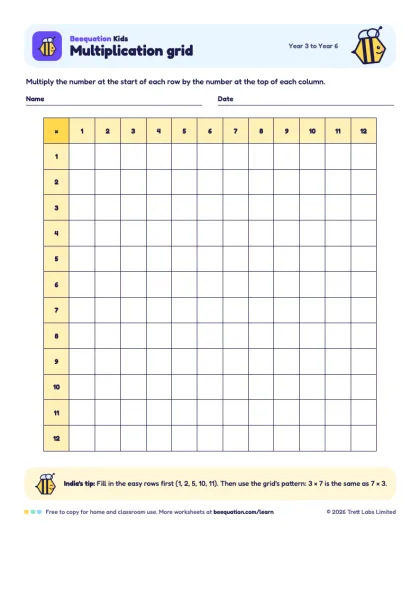 Multiplication gridYear 3, Year 4, Year 5, Year 6 · Fill in the 12 × 12 gridDownload PDF
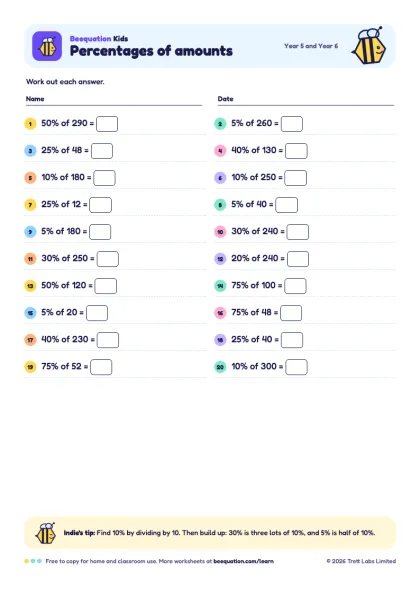 Percentages of amountsYear 5, Year 6 · 10%, 25%, 50% and moreDownload PDF
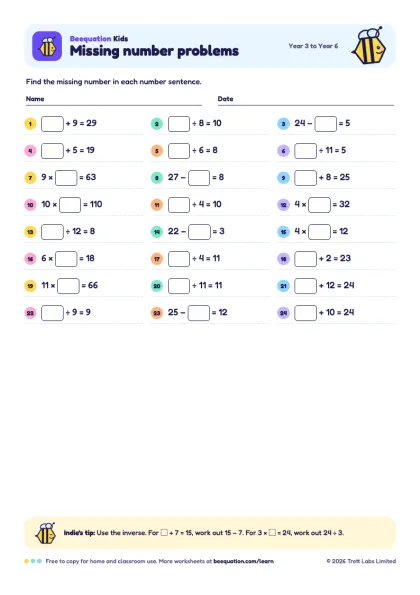 Missing number problemsYear 3, Year 4, Year 5, Year 6 · Find the number in the boxDownload PDF
Quick answers
In May of Year 6. There are three maths papers: a 30-minute arithmetic paper and two 40-minute reasoning papers, as well as reading and grammar, punctuation and spelling papers.
No. Calculators aren't allowed in any of the Key Stage 2 maths papers, which is why written methods and mental maths matter so much in Year 6.
Results are scaled scores from 80 to 120. A score of 100 or more means your child has reached the expected standard for the end of Key Stage 2.
Ratio and proportion, algebra, long division, the order of operations, the area of triangles and parallelograms, volume, pie charts and the mean.
Practise with Indie
Beequation Kids turns number facts into honeycomb puzzles, with Indie giving a hint when a child is stuck. No ads and no data collected.