Learn › Topics › Decimals and percentages
Topic guide
Decimals and percentages
A decimal is a way of writing a number that includes parts of a whole, using a decimal point. In 2.5, the 2 is whole ones and the 5 is five tenths, so 2.5 is two and a half. A percentage is a number out of 100: 50% (fifty per cent) means 50 out of every 100, which is the same as a half. Fractions, decimals and percentages are three ways of writing the same amounts, and by Year 6 children move between them freely.
What children learn, year by year
This follows the National Curriculum in England. US grades are roughly one year behind the UK year number.
| Year | What they learn |
|---|---|
| Year 3 | Count up and down in tenths. Understand that a tenth comes from splitting something into 10 equal parts. (Tenths are written as fractions, like ³⁄₁₀, at this stage.) |
| Year 4 | Count in hundredths. Write tenths and hundredths as decimals (0.3, 0.07). Know that ¼ = 0.25, ½ = 0.5 and ¾ = 0.75. Divide by 10 and 100. Round a number with one decimal place to the nearest whole number. Compare decimals with up to two decimal places, including in money and measures. |
| Year 5 | Thousandths. Write decimals as fractions (0.71 = ⁷¹⁄₁₀₀). Round to the nearest whole number and to one decimal place. Order numbers with up to three decimal places. Multiply and divide by 10, 100 and 1,000. The per cent sign (%), and percentages as fractions and decimals. |
| Year 6 | The value of each digit to three decimal places. Turn fractions into decimals by dividing (⅜ = 0.375). Multiply decimals by whole numbers (1.25 × 3 = 3.75). Find percentages of amounts, such as 15% of 360. Know the common fraction, decimal and percentage equivalents. |
The big ideas
1. Decimals carry place value past the ones
Each place value column is worth a tenth of the column to its left, and that pattern carries on after the ones. The decimal point sits between the ones and the tenths. One whole split into 10 equal parts gives tenths, a tenth split into 10 gives hundredths, and a hundredth split into 10 gives thousandths.
Money is a good way in. £3.45 is 3 whole pounds, 4 tenths of a pound (four 10p coins) and 5 hundredths of a pound (five 1p coins).
2. Longer doesn't mean bigger
Is 0.45 bigger than 0.5? Many children say yes, because 45 is bigger than 5. But 0.5 is 5 tenths, and 0.45 is only 4 tenths and 5 hundredths. Writing 0.5 as 0.50 makes it clear: 50 hundredths is more than 45 hundredths. To compare decimals, line up the decimal points and compare column by column from the left, as with whole numbers.
3. Multiplying and dividing by 10, 100 and 1,000 moves the digits
When you multiply by 10, every digit moves one place to the left, so it is worth ten times more: 3.6 × 10 = 36. When you divide by 10, every digit moves one place to the right: 3.6 ÷ 10 = 0.36. Multiplying or dividing by 100 moves the digits two places, and by 1,000 three places. The decimal point itself stays put; it is the digits that move.
4. Rounding decimals works the same way
To round to the nearest whole number, look at the tenths digit: 5 or more rounds up, 4 or less rounds down. So 4.68 rounds to 5, and 3.14 rounds to 3. To round to one decimal place, look at the hundredths digit: 4.68 rounds to 4.7, and 3.14 rounds to 3.1. Rounding is useful for estimating with money and measurements.
Shopping is the best decimals practice there is. Ask your child to round prices to the nearest pound and estimate the total before you reach the till: £1.89 + £2.35 + £0.99 is about £2 + £2 + £1 = £5 (the real total is £5.23). Price labels that show "per 100 g" or a percentage off in a sale are good talking points too.
5. Per cent means "out of 100"
"Per cent" means "for every hundred". A hundred square shows it well: each small square is 1%, a whole row of ten is 10%, and the whole square is 100%. Because a percentage is a number of hundredths, it is quick to write as a fraction or a decimal: 35% = ³⁵⁄₁₀₀ = 0.35, and 7% = ⁷⁄₁₀₀ = 0.07.
6. Finding a percentage of an amount
Children build percentages from ones they can find quickly:
- 50% is half, so divide by 2. 50% of 60 is 30.
- 25% is a quarter, so divide by 4. 25% of 60 is 15.
- 10% is a tenth, so divide by 10. 10% of 60 is 6.
- 1% is a hundredth, so divide by 100. 1% of 600 is 6.
Then they combine them. 30% of 60 is three lots of 10%: 6 × 3 = 18. For 15% of 360: 10% is 36, 5% is half of that, 18, so 15% is 36 + 18 = 54.
7. Fractions, decimals and percentages are the same amounts
By Year 6, children should know the common equivalents well:
| Fraction | Decimal | Percentage |
|---|---|---|
| ½ | 0.5 | 50% |
| ¼ | 0.25 | 25% |
| ¾ | 0.75 | 75% |
| ⅕ | 0.2 | 20% |
| ⅖ | 0.4 | 40% |
| ⅒ | 0.1 | 10% |
| ¹⁄₁₀₀ | 0.01 | 1% |
| ⅛ | 0.125 | 12.5% |
To turn any fraction into a decimal, divide the top number by the bottom number: ⅜ = 3 ÷ 8 = 0.375.
Common mistakes to look out for
- Longer is bigger: thinking 0.45 > 0.5, or that 0.125 is bigger than 0.2.
- Reading decimals as whole numbers: saying 0.25 as "nought point twenty-five". Saying "nought point two five" keeps the place value clear.
- Adding a zero to multiply by 10: writing 3.6 × 10 = 3.60. The digits need to move, giving 36.
- Mixing up tenths and hundredths: writing ⁷⁄₁₀₀ as 0.7 instead of 0.07.
- Money muddles: reading £2.5 on a calculator as £2.05. It means £2.50.
- Thinking 0.3 is a third: ⅓ is 0.333… (the 3s go on forever), which is a little more than 0.3.
Five-minute decimal and percentage games for home
- Price round-up. Pick three things in a shop or online. Round each price to the nearest pound and estimate the total.
- Measure up. Measure family members in metres. Who is 1.32 m? Who is 1.4 m? Put everyone in order of height.
- Sale detective. Spot "20% off" or "half price" signs. What would £30 shoes cost with 20% off? (10% is £3, so 20% is £6, and the shoes cost £24.)
- Battery check. A phone or tablet showing 40% battery has 40 out of 100 left. What fraction is that? (⅖.)
- Match three. Write fractions, decimals and percentages on cards (¼, 0.25, 25%) and find the sets of three.
Indie's challengeIndie has a jar holding 2 litres of honey. She uses 35% of it to make honey cakes. How much honey does she use, and how much is left? Show the answer
2 litres is 2,000 ml. 10% of 2,000 ml is 200 ml, so 30% is 600 ml and 5% is 100 ml. That makes 35% = 600 + 100 = 700 ml (0.7 litres). Left in the jar: 2,000 − 700 = 1,300 ml, which is 1.3 litres, or 65% of the honey.
Free decimals and percentages worksheets
Print these for practice at home or in class. Each one has an answer sheet on the second page.
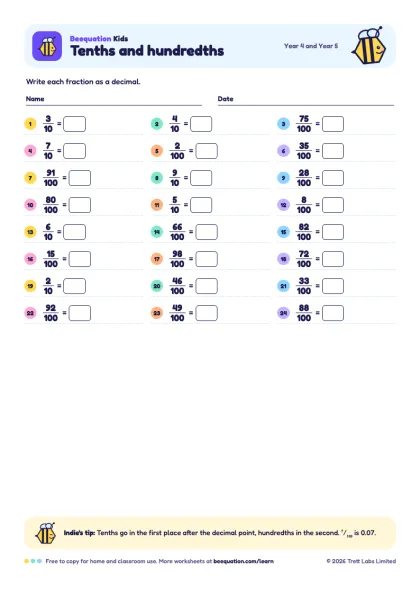 Tenths and hundredthsYear 4, Year 5 · Fractions as decimalsDownload PDF
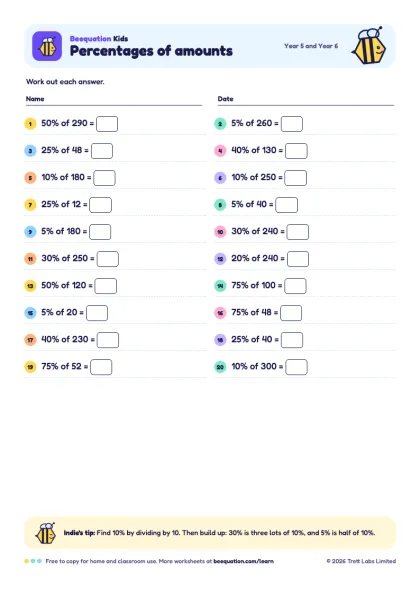 Percentages of amountsYear 5, Year 6 · 10%, 25%, 50% and moreDownload PDF
Quick answers
Nought point two five (or zero point two five). Saying each digit after the point separately helps children remember that the 2 is 2 tenths and the 5 is 5 hundredths.
They count in tenths in Year 3, and start writing decimals such as 0.3 and 0.07 in Year 4 (age 8 to 9). Percentages come in Year 5.
Divide it by 10. 10% of 80 is 8, and 10% of £4.50 is 45p. Lots of other percentages can be built from 10%.
Yes. 100% is the whole amount, so 150% is one and a half times as much. 150% of 20 is 30.
Practise with Indie
Beequation Kids turns number facts into honeycomb puzzles, with Indie giving a hint when a child is stuck. No ads and no data collected.