Learn › Topics › Telling the time
Topic guide
Telling the time
Telling the time means reading a clock and saying what time it is, in words ("quarter past three") and in numbers (3:15). It also covers working out how long something takes, using a calendar, and knowing how seconds, minutes, hours, days, weeks, months and years fit together.
It is one of the trickiest things children learn in primary school. A clock face uses the same numbers for two different jobs, and time is counted in 60s, not 10s like the rest of maths. Expect it to take a few years, with lots of practice on a real clock.
What children learn, year by year
This follows the National Curriculum in England. US grades are roughly one year behind the UK year number. Before Year 1, children in Reception mostly meet time through daily routines: what comes first, next and after lunch.
| Year | What they learn |
|---|---|
| Year 1 | Put events in order using words like before, after, first, next, today, yesterday and tomorrow. Name the days of the week and the months. Tell the time to the hour and half past the hour, and draw the hands on a clock face. |
| Year 2 | Tell and write the time to five minutes, including quarter past and quarter to. Know there are 60 minutes in an hour and 24 hours in a day. Compare and order lengths of time. |
| Year 3 | Tell the time to the nearest minute, including on clocks with Roman numerals I to XII. Use am and pm, noon and midnight, and read 12-hour and 24-hour clocks. Know there are 60 seconds in a minute and how many days are in each month, a year and a leap year. Compare how long things take. |
| Year 4 | Convert between analogue and digital times, and between 12-hour and 24-hour clocks. Convert hours to minutes, minutes to seconds, years to months and weeks to days. |
| Year 5 | Solve problems that involve converting between units of time. Read and use timetables. |
| Year 6 | Convert between units of time as part of bigger measurement problems, such as turning 150 minutes into 2 hours 30 minutes or 2½ hours. |
The big ideas
1. Two hands, two jobs
The short hand is the hour hand. The long hand is the minute hand. Start with o'clock: when the minute hand points straight up to 12, the hour hand tells you which o'clock it is. Then half past: the minute hand points straight down to 6, and the hour hand sits halfway between two numbers. At half past 4, the hour hand is halfway between 4 and 5.
That halfway point matters. The hour hand moves slowly all the time, so it only points exactly at a number on the hour.
2. Each number on the clock is 5 minutes
The numbers on a clock are really for the hours. For the minutes, children count in fives around the clock: the 1 means 5 minutes, the 2 means 10, the 3 means 15, and so on up to 60 at the 12. This is why counting in fives in Year 1 and Year 2 is such good preparation.
Split the clock down the middle. When the minute hand is on the right-hand side, we say past the hour we've just had. On the left-hand side, we say to the next hour. So 3:15 is quarter past 3, 3:40 is twenty to 4 (there are 20 minutes to go until 4:00), and 3:45 is quarter to 4. Year 3 children then read the small marks in between to tell the time to the nearest minute: 3:17 is seventeen minutes past 3.
3. Analogue and digital are two ways of saying the same time
An analogue clock has hands. A digital clock shows numbers, with the hour first and the minutes after the colon. Digital times are always given in minutes past the hour, so "twenty to 4" is 3:40, not 4:20. Ask your child to say both versions: "3:40, that's twenty to 4."
4. am, pm and the 24-hour clock
The hour hand goes round twice a day, so 7:00 could be breakfast or bedtime. am means between midnight and midday (noon). pm means between noon and midnight.
The 24-hour clock avoids the muddle by carrying on counting after 12. For a pm time, add 12 to the hour: 7:20 pm is 19:20, and 3:15 pm is 15:15. To go back, take 12 away: 16:45 is 4:45 pm. Midnight is 00:00 and midday is 12:00. 24-hour times usually have four digits, so 7:05 am is written 07:05.
Put an analogue clock where your child can see it every day, and talk about it out loud: "It's twenty past 4. We leave for swimming at half past. How many minutes is that?" A few seconds of real-life clock talk each day does more than a long practice session once a week.
5. Time doesn't count in tens
There are 60 minutes in an hour, not 100. So you can't work out how long something takes by subtracting times like ordinary numbers. Instead, count on to the next o'clock, then in whole hours, then the minutes left. For a film that starts at 2:45 pm and ends at 4:20 pm:
- 2:45 to 3:00 is 15 minutes
- 3:00 to 4:00 is 1 hour
- 4:00 to 4:20 is 20 minutes
Altogether, 1 hour 35 minutes. Drawing this as jumps on a number line (a "time line") helps a lot.
6. Calendars and units of time
These are the facts children need to know by heart by Year 4:
| Unit | Equals |
|---|---|
| 1 minute | 60 seconds |
| 1 hour | 60 minutes |
| 1 day | 24 hours |
| 1 week | 7 days |
| 1 year | 12 months, 52 weeks and 1 day, or 365 days (366 in a leap year) |
A leap year comes every four years, when February has 29 days instead of 28. The next one is 2028. For the other months, try the knuckle trick: make two fists side by side, and count the months across your knuckles and the dips between them, starting with January on the first knuckle. July lands on the last knuckle of one hand and August on the first knuckle of the other. Months that land on a knuckle (January, March, May, July, August, October, December) have 31 days. The dips have 30, apart from February.
Converting means multiplying or dividing: 3 hours is 3 × 60 = 180 minutes, 3 weeks is 21 days, 2 years is 24 months, and 150 seconds is 2 minutes 30 seconds.
Common mistakes to look out for
- Mixing up the hands: reading the long hand as the hours.
- Reading the hour too early or too late: at 2:50 the hour hand is nearly on 3, so children often say "ten to 2" instead of ten to 3. Check: has the hour hand passed the number yet?
- Writing "to" times backwards: writing twenty to 4 as 4:20 instead of 3:40.
- Treating time like decimals: 1:50 plus 20 minutes is 2:10, not 1:70. And 1.5 hours is 1 hour 30 minutes, not 1 hour 50 minutes.
- Taking away 10 for the 24-hour clock: thinking 15:00 is 5 o'clock. It's 3 pm, because you take away 12.
Five-minute time games for home
- What's the time, Mr Wolf? Play the playground game, but the "wolf" has to show the time on a toy clock or say a real time like "quarter past 2".
- Guess a minute. Everyone closes their eyes and puts a hand up when they think one minute has passed. Who was closest? Try 30 seconds next.
- Countdown calendar. How many days until a birthday, a holiday or the end of term? How many weeks is that?
- Timetable detective. Look at a bus or train timetable (or the TV guide). "If we catch the 16:35, what time do we get there? How long is the journey?"
Indie's challengeIndie starts collecting nectar at 10:40 am and finishes at 1:15 pm. How long does she spend collecting? Show the answer
Count on in jumps. 10:40 to 11:00 is 20 minutes. 11:00 am to 1:00 pm is 2 hours. 1:00 to 1:15 is 15 minutes. Altogether that's 2 hours 35 minutes (20 + 15 = 35 minutes, plus the 2 hours).
Free telling the time worksheets
Print these for practice at home or in class. Each one has an answer sheet on the second page.
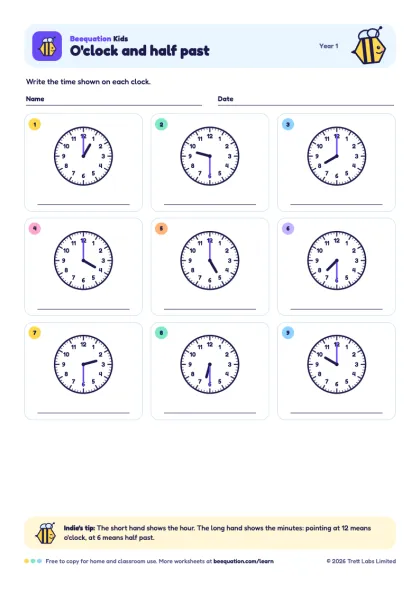 O'clock and half pastYear 1 · Read the clocksDownload PDF
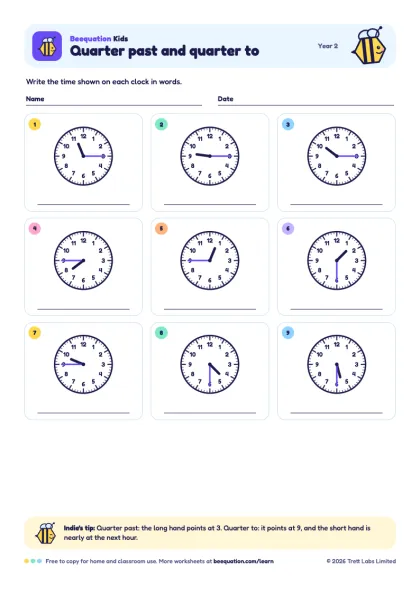 Quarter past and quarter toYear 2 · Read the clocksDownload PDF
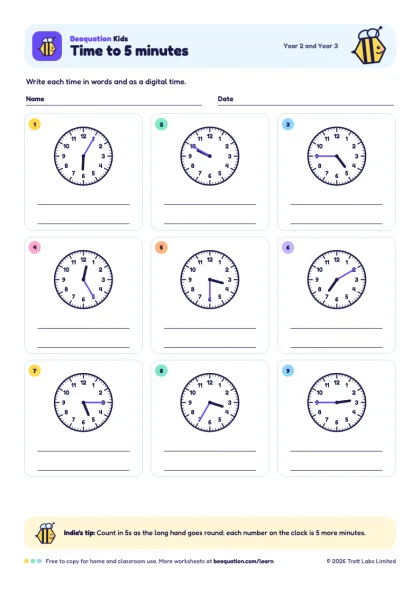 Time to 5 minutesYear 2, Year 3 · Read the clocksDownload PDF
Quick answers
Children learn o'clock and half past in Year 1 (age 5 to 6), five-minute times in Year 2 and the time to the nearest minute in Year 3 (age 7 to 8). Many children need longer than this, and that's normal: regular practice with a real clock is what helps.
Both are useful, but an analogue watch or clock gives more practice with the harder skill. Reading the hands also shows how much time is left, which a digital display doesn't.
If the hour is more than 12, take 12 away and add pm: 18:30 is 6:30 pm. If it is 12, it's pm (12:45 is 12:45 pm). If it is 00, it's 12 am (00:20 is 12:20 am). Anything else is am.
Practise with Indie
Beequation Kids turns number facts into honeycomb puzzles, with Indie giving a hint when a child is stuck. No ads and no data collected.