Learn › Year groups › Year 2
Year group guide
Year 2 maths: what your child learns (age 6 to 7)
Year 2 is for children aged 6 to 7, roughly the same as Grade 1 in the US. It's the last year of Key Stage 1 (infants). Children work with numbers up to 100, learn their first times tables, use money to give change and tell the time to five minutes.
What Year 2 children are working on
The big idea in Year 2 is place value: knowing that the 4 in 47 means 4 tens, or 40, and the 7 means 7 ones. Once that clicks, children can add and subtract two-digit numbers in their heads by working with the tens and the ones separately.
Children are also expected to know their number bonds to 20 quickly and to use them for bigger numbers: if 3 + 7 = 10, then 30 + 70 = 100. And they start to see multiplication as equal groups, learning the 2, 5 and 10 times tables.
The Year 2 maths curriculum
This follows the National Curriculum in England. Each heading links to a full guide to that topic.
Number and place value
- Count in steps of 2, 3 and 5 from 0, and in 10s from any number, forwards and backwards (23, 33, 43…).
- Know the value of each digit in a two-digit number: 47 is 4 tens and 7 ones.
- Show and estimate numbers in different ways, including on a number line.
- Compare and order numbers from 0 to 100, using the signs <, > and =: 52 > 47.
- Read and write numbers to at least 100 in numerals and in words.
Addition and subtraction
- Recall addition and subtraction facts to 20 quickly, and use them for related facts to 100: 3 + 7 = 10, so 30 + 70 = 100.
- Add and subtract with objects, pictures and in their heads: a two-digit number and ones (45 + 3 = 48), a two-digit number and tens (45 + 20 = 65), two two-digit numbers (45 + 32 = 77) and three one-digit numbers (5 + 3 + 5 = 13).
- Understand that addition can be done in any order (4 + 9 = 9 + 4) but subtraction can't.
- Use the link between addition and subtraction to check answers and solve missing number problems: □ + 6 = 15, so the missing number is 15 − 6 = 9.
- Solve problems with numbers, quantities and measures.
Multiplication and division
- Recall and use the 2, 5 and 10 times tables and the matching division facts.
- Recognise odd and even numbers.
- Write multiplication and division number sentences with ×, ÷ and =.
- Understand that multiplication can be done in any order (4 × 5 = 5 × 4 = 20) but division can't (20 ÷ 5 = 4, but 5 ÷ 20 is not 4).
- Solve problems using arrays, repeated addition and times table facts.
Fractions
- Find, name and write ⅓, ¼, ²⁄₄ and ¾ of a length, a shape, a group of objects or an amount: ¼ of 12 is 3, and ¾ of 12 is 9.
- Write simple fraction facts such as ½ of 6 = 3.
- Recognise that ²⁄₄ is the same as ½.
Measurement: length, mass, capacity, temperature
- Choose the right units and equipment to estimate and measure length and height (m and cm, with a ruler), mass (kg and g, with scales), temperature (°C, with a thermometer) and capacity (litres and ml, with a measuring jug).
- Compare and order measurements using <, > and =.
Measurement: money
- Use the symbols £ and p.
- Combine coins to make an amount: 20p + 20p + 5p + 2p = 47p.
- Find different ways to make the same amount.
- Solve simple problems with adding and subtracting money, including giving change.
Measurement: time
- Tell and write the time to five minutes, including quarter past and quarter to, and draw the hands on a clock.
- Know there are 60 minutes in an hour and 24 hours in a day.
- Compare and put in order lengths of time.
Geometry: properties of shapes
- Describe 2D shapes by their number of sides and whether they have a vertical line of symmetry.
- Describe 3D shapes by their faces, edges and vertices (corners): a cube has 6 faces, 12 edges and 8 vertices.
- Find 2D shapes on the surfaces of 3D shapes, such as a circle on a cylinder or a triangle on a pyramid.
- Compare and sort shapes and everyday objects.
Geometry: position and direction
- Make and continue patterns and sequences of shapes and objects.
- Describe position, direction and movement, including moving in a straight line and turning.
- Know that quarter, half and three-quarter turns are one, two and three right angles, and turn clockwise and anti-clockwise.
Statistics
- Read and make simple pictograms, tally charts, block diagrams and tables.
- Answer questions by counting how many are in each group, sorting the groups by size, and finding totals and differences: "How many more children chose apples than bananas?"
By the end of Year 2, most children can…
- read, write and order numbers to 100, and say what each digit is worth
- recall addition and subtraction facts to 20 quickly
- add and subtract two-digit numbers, such as 45 + 32 = 77 and 68 − 25 = 43
- recall the 2, 5 and 10 times tables and the division facts that go with them
- say whether a number is odd or even
- find ⅓, ¼, ½ and ¾ of shapes and small amounts
- measure with a ruler, scales and a measuring jug
- make amounts of money with coins and work out simple change
- tell the time to five minutes
- count the faces, edges and vertices of 3D shapes
- read and make a simple pictogram, tally chart or block diagram
Key vocabulary
| Word | What it means |
|---|---|
| Tens and ones | The two parts of a two-digit number: 36 is 3 tens and 6 ones. |
| Place value | What a digit is worth because of where it is: the 3 in 36 is worth 30. |
| < and > | Less than and greater than. The small, pointed end faces the smaller number: 29 < 31. |
| Inverse | The opposite operation, used to check: 15 − 6 = 9, so 9 + 6 = 15. |
| Multiply, times, groups of | 3 × 5 means 3 groups of 5, or 5 three times. |
| Divide, share, group | Split into equal groups: 20 ÷ 5 = 4. |
| Odd, even | Even numbers end in 0, 2, 4, 6 or 8. Odd numbers end in 1, 3, 5, 7 or 9. |
| Face, edge, vertex | A flat surface, the line where two faces meet, and a corner (more than one are vertices). |
| Line of symmetry | A fold line that splits a shape into two matching halves. |
| Tally chart, pictogram | Ways of recording data: tally marks in groups of 5, or pictures that each stand for an amount. |
Tests in Year 2
Year 2 is the end of Key Stage 1. The Key Stage 1 SATs (an arithmetic paper and a reasoning paper in maths) stopped being compulsory from 2023/24. Some schools still use the papers, usually in May, to help teachers judge how children are doing. If your child's school uses them, they're normally done in the classroom in a low-key way, and there's no need to practise at home.
Next up is the Multiplication Tables Check in Year 4. The 2, 5 and 10 times tables are the first step.
How to help at home
- Count in 2s, 5s and 10s together. Say the times tables while walking, climbing stairs or bouncing a ball. See our times tables practice ideas.
- Let your child pay. In a shop, let them choose the coins, then work out the change together by counting up.
- Ask the time. Have an analogue clock at home and ask "what time is it?" at five-minute moments: 8:05, 8:10, 8:15.
- Bake. Weighing flour in grams and measuring milk in millilitres is real measuring practice.
- Make a tally chart. Count the colours of cars going past for five minutes, then talk about which colour came top.
- Split numbers into tens and ones. "What's 34 + 20? What about 34 + 25?"
When your child gives change, ask them to count up rather than take away. For 35p from 50p, start at 35p, add 5p to get to 40p, then add 10p to get to 50p. 5p + 10p is 15p change. It's how many people work out change in their heads, and it works for bigger amounts later.
Indie's challengeIndie buys a honey lolly for 35p. She pays with a 50p coin. How much change does she get? Show the answer
Indie gets 15p change. Count up from 35p: 5p takes you to 40p, then 10p more takes you to 50p. 5p + 10p = 15p. Check: 35p + 15p = 50p.
Free Year 2 maths worksheets
Print these for practice at home or in class. Each one has an answer sheet on the second page.
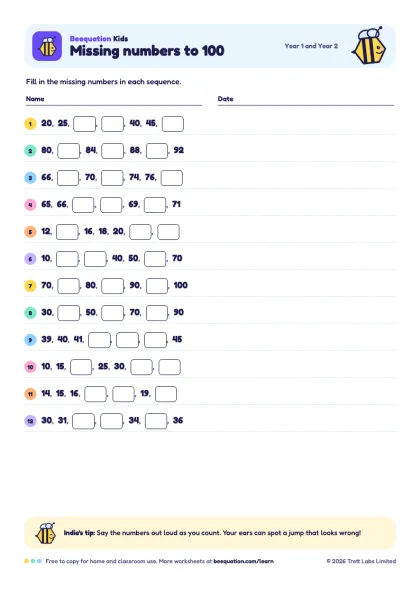 Missing numbers to 100Year 1, Year 2 · Count in 1s, 2s, 5s and 10sDownload PDF
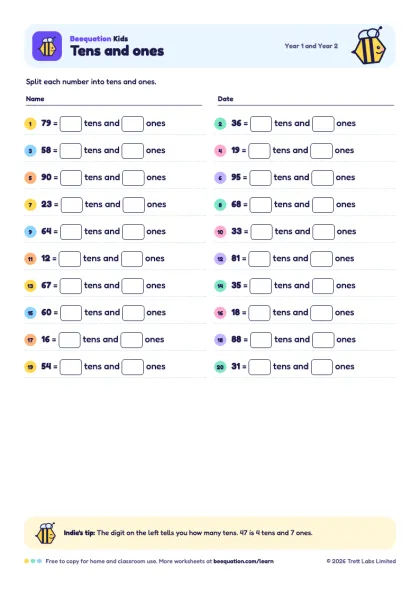 Tens and onesYear 1, Year 2 · Partition two-digit numbersDownload PDF
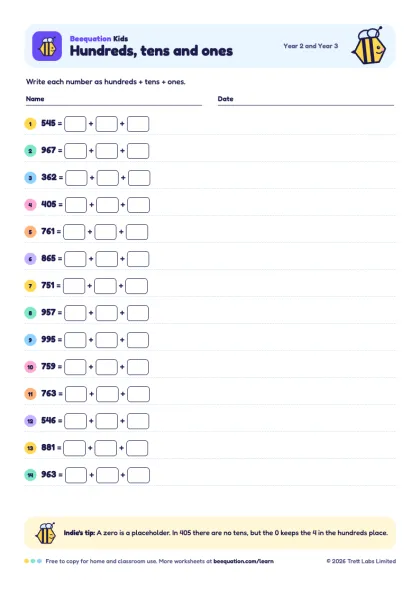 Hundreds, tens and onesYear 2, Year 3 · Place value to 1,000Download PDF
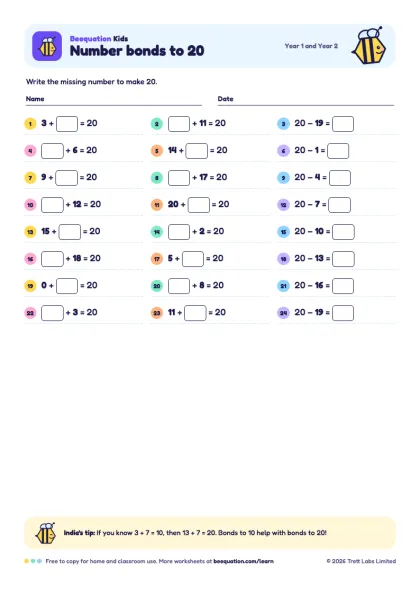 Number bonds to 20Year 1, Year 2 · Pairs that make 20Download PDF
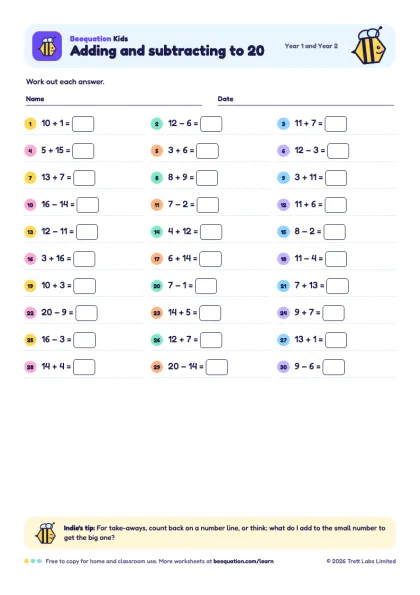 Adding and subtracting to 20Year 1, Year 2 · Mixed sums within 20Download PDF
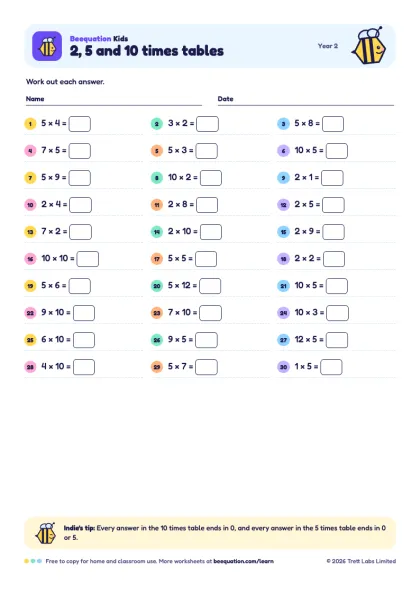 2, 5 and 10 times tablesYear 2 · Mixed questionsDownload PDF
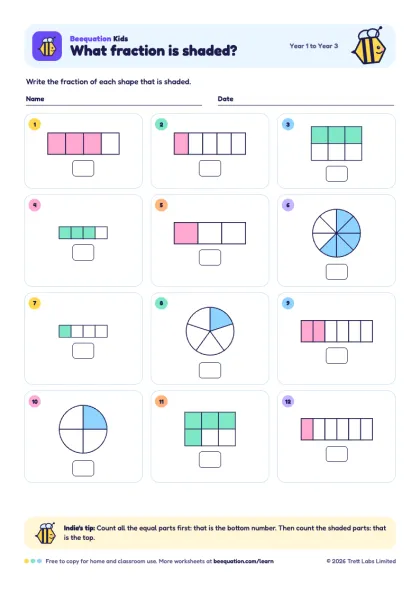 What fraction is shaded?Year 1, Year 2, Year 3 · Halves, thirds, quarters and moreDownload PDF
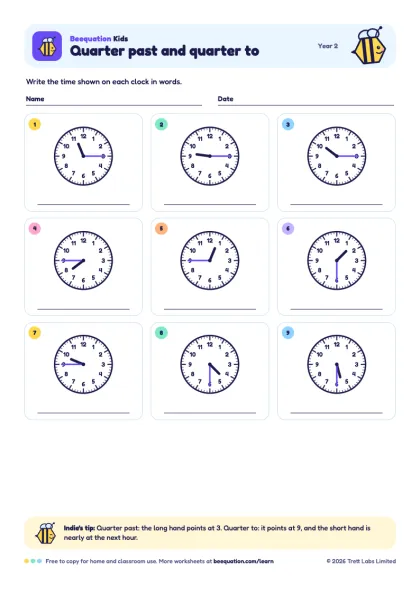 Quarter past and quarter toYear 2 · Read the clocksDownload PDF
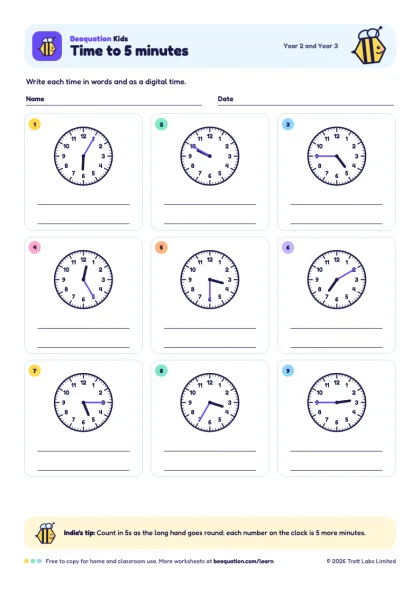 Time to 5 minutesYear 2, Year 3 · Read the clocksDownload PDF
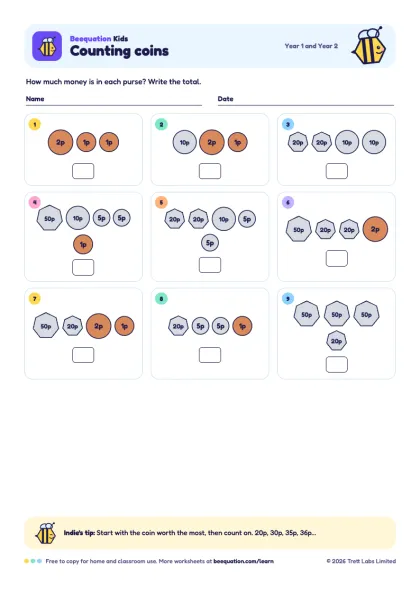 Counting coinsYear 1, Year 2 · Add up UK coinsDownload PDF
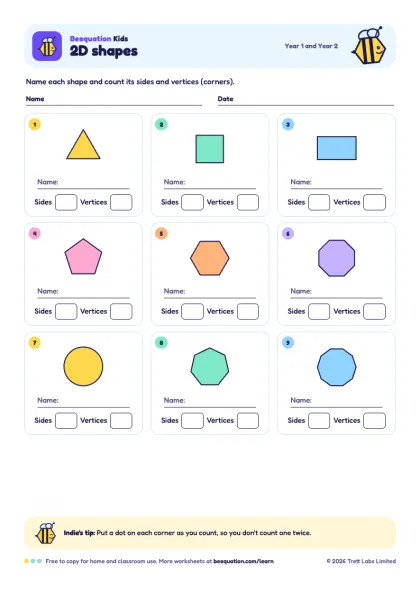 2D shapesYear 1, Year 2 · Names, sides and verticesDownload PDF
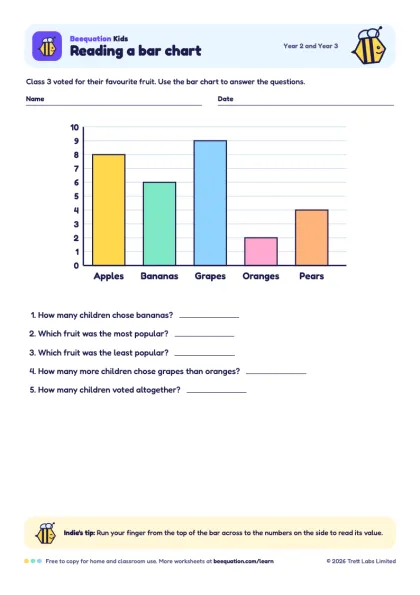 Reading a bar chartYear 2, Year 3 · Favourite fruit surveyDownload PDF
Quick answers
No. The Key Stage 1 SATs stopped being compulsory from 2023/24. Some schools still choose to use the papers to help teachers see how children are getting on.
The 2, 5 and 10 times tables, and the division facts that go with them (like 30 ÷ 5 = 6). They also count in 3s. The 3, 4 and 8 times tables come in Year 3.
An even number of things can be put into pairs with none left over. An odd number always has one left over. With bigger numbers, look at the last digit: 0, 2, 4, 6 and 8 mean even.
How to tell the time to five minutes on a clock with hands, including quarter past and quarter to, and that there are 60 minutes in an hour and 24 hours in a day.
Practise with Indie
Beequation Kids turns number facts into honeycomb puzzles, with Indie giving a hint when a child is stuck. No ads and no data collected.