Learn › Topics › Shape and geometry
Topic guide
Shape and geometry
Geometry is the part of maths about shape, size and position. In primary school it covers naming and describing 2D shapes (flat shapes like squares and triangles) and 3D shapes (solid shapes like cubes and spheres), symmetry, angles, and position and direction: describing where things are and how they move, including coordinates.
What children learn, year by year
This follows the National Curriculum in England and the EYFS framework for Reception. US grades are roughly one year behind the UK year number.
| Year | What they learn |
|---|---|
| Reception | Explore and talk about shapes using words like sides, corners, straight, flat and round. Turn, fit together and build with shapes, and see that a shape can be made from smaller shapes. Copy, continue and make repeating patterns. |
| Year 1 | Name common 2D shapes (rectangles including squares, circles, triangles) and 3D shapes (cuboids including cubes, pyramids, spheres). Describe position and direction, including whole, half, quarter and three-quarter turns. |
| Year 2 | Count the sides of 2D shapes and find a vertical line of symmetry. Count the faces, edges and vertices of 3D shapes. Spot 2D shapes on the faces of 3D shapes. Describe turns as clockwise or anticlockwise, and in right angles. |
| Year 3 | Draw 2D shapes and make 3D shapes. See angles as a turn. Find right angles and say whether an angle is bigger or smaller than one. Spot horizontal, vertical, parallel and perpendicular lines. |
| Year 4 | Sort triangles and quadrilaterals by their properties. Name acute and obtuse angles. Find lines of symmetry in shapes facing any direction, and complete symmetric pictures. Use coordinates and describe translations (slides). |
| Year 5 | Measure and draw angles in degrees with a protractor. Know acute, obtuse and reflex angles, angles on a straight line (180°) and around a point (360°). Regular and irregular polygons. Reflect and translate shapes. |
| Year 6 | Find missing angles in triangles, quadrilaterals and regular polygons, and where lines cross. Name the parts of a circle: radius, diameter and circumference. Make nets of 3D shapes. Use coordinates in all four quadrants, and translate and reflect shapes on them. |
The big ideas
1. 2D shapes: sides and vertices
A 2D shape is flat. A shape with straight sides that join up all the way round is a polygon. Its corners are called vertices (one is a vertex). Polygons are named by how many sides they have:
| Sides | Name | Sides | Name |
|---|---|---|---|
| 3 | triangle | 7 | heptagon |
| 4 | quadrilateral | 8 | octagon |
| 5 | pentagon | 9 | nonagon |
| 6 | hexagon | 10 | decagon |
A regular polygon has all its sides the same length and all its angles the same size. An irregular one doesn't. A stop sign is a regular octagon. Any 4-sided shape is a quadrilateral, and that family includes the square, rectangle, rhombus, parallelogram, trapezium and kite. A square is a special kind of rectangle, because it has four right angles. Triangles can be equilateral (all sides equal), isosceles (two sides equal), scalene (no sides equal) or right-angled.
2. 3D shapes: faces, edges and vertices
A 3D shape is solid. Its flat surfaces are faces, the lines where two faces meet are edges, and the corners are vertices.
| Shape | Faces | Edges | Vertices | Everyday example |
|---|---|---|---|---|
| Cube | 6 | 12 | 8 | a dice |
| Cuboid | 6 | 12 | 8 | a cereal box |
| Square-based pyramid | 5 | 8 | 5 | the pyramids in Egypt |
| Triangular prism | 5 | 9 | 6 | a chocolate bar box with triangle ends |
| Triangular-based pyramid (tetrahedron) | 4 | 6 | 4 | some tea bags |
Spheres, cylinders and cones have curved surfaces. A sphere has one curved surface; a cylinder has two flat circular faces and one curved surface.
3. Symmetry
A line of symmetry (or mirror line) splits a shape into two halves that are reflections of each other. If you cut the shape out and fold it along the line, the halves match exactly. A regular polygon has as many lines of symmetry as it has sides. A circle has an infinite number: any line through its centre works.
4. Angles are turns
An angle is an amount of turn. Children first meet turns with their bodies: a quarter turn, a half turn, a whole turn. A quarter turn is a right angle, the square corner you see on a book or a door frame. Two right angles make a half turn, and four make a whole turn.
In Year 5, children measure angles in degrees. A whole turn is 360°, a half turn (a straight line) is 180° and a right angle is 90°. Angles get their names from their size:
- Acute: less than 90°
- Right angle: exactly 90°
- Obtuse: more than 90° but less than 180°
- Reflex: more than 180° but less than 360°
To measure with a protractor: put the small cross at the centre of the protractor exactly on the vertex, line up the zero line with one arm, then follow the scale that starts at 0 on that arm round to the other arm. Protractors have two scales, and reading the wrong one is the most common slip: it gives 130° for a 50° angle. Ask "is this angle acute or obtuse?" first, so your child knows roughly what answer to expect.
Make a right-angle tester by folding a scrap of paper in half and then in half again. The folded corner is a right angle. Your child can hunt around the house for angles and check whether each one is a right angle, smaller (acute) or bigger (obtuse).
5. Angle facts
From Year 5 and Year 6, children use a few facts to find missing angles without measuring:
- Angles on a straight line add up to 180°. If one angle is 35°, the other is 180° − 35° = 145°.
- Angles around a point add up to 360°.
- The angles inside a triangle add up to 180°. If two angles are 50° and 70°, the third is 180° − 120° = 60°.
- The angles inside a quadrilateral add up to 360°.
- Where two straight lines cross, the angles opposite each other (vertically opposite angles) are equal.
6. Position, direction and coordinates
Young children describe position with words like above, below, next to, left and right, and give directions such as "forward 3 steps, then a quarter turn clockwise". From Year 4, they use coordinates to name a point on a grid. The first number goes across (the x-axis) and the second goes up (the y-axis): to find (3, 5), go 3 across and 5 up. "Along the corridor, then up the stairs" helps children remember the order.
A translation slides a shape without turning it. Move the point (2, 1) 3 squares right and 2 squares up and it lands on (5, 3). A reflection flips a shape over a mirror line, and each point ends up the same distance from the line on the other side. In both cases the shape keeps its size. In Year 6, the grid extends to negative numbers, so reflecting the point (2, 3) in the y-axis gives (−2, 3).
Common mistakes to look out for
- "It's a diamond": a square turned on its corner is still a square. A diamond-like shape with equal sides but no right angles is a rhombus.
- A square isn't a rectangle: it is. It's a rectangle whose sides are all the same length.
- Only knowing the "usual" picture: recognising a triangle only when it sits flat on its base. Show shapes at all angles, sizes and colours.
- Diagonals as lines of symmetry: folding a rectangle along its diagonal doesn't make the halves match. Try it with paper.
- Longer arms, bigger angle: the size of an angle is the amount of turn, not the length of the lines.
- Coordinates the wrong way round: going up before across. Across first, then up.
Five-minute shape games for home
- Shape hunt. Find a cylinder, a cuboid and a sphere in the kitchen. Count the faces, edges and vertices of a cereal box together.
- Butterfly paint. Drop paint on one half of a sheet of paper, fold along the middle and open it. The fold is a line of symmetry.
- Robot directions. Your child gives you instructions to walk to the sofa: "forward 4 steps, quarter turn anticlockwise, forward 2."
- Coordinate battleships. Draw two small grids, hide some "ships" on points, and take turns calling coordinates to find each other's.
Indie's challengeEach corner inside one of Indie's hexagon honeycomb cells is 120°. Three cells meet at every point. What do the three angles add up to, and why does it matter? Show the answer
3 × 120° = 360°, which is a whole turn. Because the three angles make exactly 360°, the hexagons fit together around each point with no gaps and no overlaps. That's why honeycomb has no wasted space.
Free shape and geometry worksheets
Print these for practice at home or in class. Each one has an answer sheet on the second page.
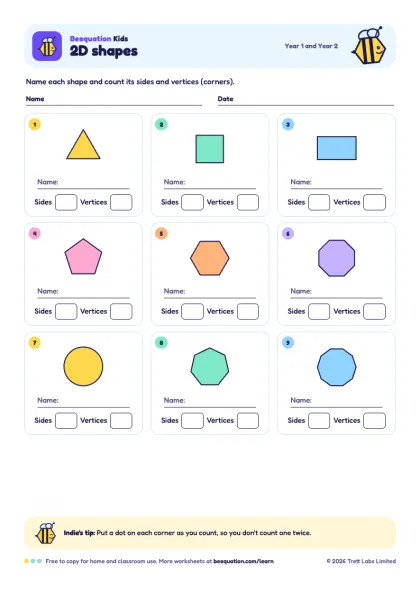 2D shapesYear 1, Year 2 · Names, sides and verticesDownload PDF
Quick answers
Yes. A rectangle is a four-sided shape with four right angles, and a square has those. A square is a special rectangle with all four sides the same length.
An infinite number. Any straight line through the centre of a circle is a line of symmetry.
In Year 5 (age 9 to 10), when they start measuring and drawing angles in degrees. In Year 6 they use protractors to draw shapes with given angles.
A flat shape with straight sides that are joined up all the way round, such as a triangle, a square or a hexagon. A circle is not a polygon, because it has no straight sides.
Practise with Indie
Beequation Kids turns number facts into honeycomb puzzles, with Indie giving a hint when a child is stuck. No ads and no data collected.