Learn › Year groups › Year 5
Year group guide
Year 5 maths: what your child learns (age 9 to 10)
Year 5 is for children aged 9 to 10, roughly the same as Grade 4 in the US. It's the third year of Key Stage 2. Numbers grow to a million, written methods get longer, and fractions, decimals and percentages start to join up into one big idea.
What Year 5 children are working on
Year 5 is a busy year. Children learn long multiplication and short division, meet prime numbers, square numbers and cube numbers, and work with fractions bigger than one. Percentages appear for the first time, alongside decimals with up to three decimal places.
In geometry, angles are measured in degrees with a protractor, and children find areas of rectangles in square centimetres. Much of what's learned this year is tested in the Key Stage 2 SATs in Year 6, so it's a good year to keep times tables sharp.
The Year 5 maths curriculum
This follows the National Curriculum in England. Each heading links to a full guide to that topic.
Number and place value
- Read, write, order and compare numbers to at least 1,000,000, and say what each digit is worth.
- Count forwards and backwards in powers of 10 (10s, 100s, 1,000s, 10,000s and 100,000s) from any number.
- Use negative numbers in context, such as temperatures: from −3 °C to 4 °C is a rise of 7 degrees.
- Round any number up to 1,000,000 to the nearest 10, 100, 1,000, 10,000 and 100,000: 247,385 rounds to 250,000 to the nearest 10,000.
- Read Roman numerals to 1,000 (M) and years written in Roman numerals: MMXXVI is 2026.
Addition and subtraction
- Add and subtract whole numbers with more than four digits, using the column method.
- Add and subtract mentally with bigger numbers: 12,462 − 2,300 = 10,162.
- Use rounding to check answers, and solve multi-step problems.
Multiplication and division
- Find multiples, factors, factor pairs and common factors: the common factors of 12 and 18 are 1, 2, 3 and 6.
- Know what prime numbers, prime factors and composite numbers are, check whether a number up to 100 is prime, and recall the primes up to 19: 2, 3, 5, 7, 11, 13, 17 and 19.
- Multiply numbers with up to four digits by a one-digit or two-digit number, including long multiplication: 24 × 36 = 864.
- Divide numbers with up to four digits by a one-digit number using short division, and deal with remainders sensibly: 437 ÷ 4 = 109 remainder 1.
- Multiply and divide whole numbers and decimals by 10, 100 and 1,000: 3.7 × 100 = 370.
- Know square numbers and cube numbers and the signs ² and ³: 5² = 5 × 5 = 25 and 2³ = 2 × 2 × 2 = 8.
- Understand the equals sign as "is the same as", and solve problems with all four operations, scaling and simple rates.
Fractions
- Compare and order fractions whose denominators are multiples of the same number: ⅔ = ⁴⁄₆, so ⁵⁄₆ is bigger than ⅔.
- Find equivalent fractions, including tenths and hundredths: ³⁄₁₀ = ³⁰⁄₁₀₀.
- Change between mixed numbers and improper fractions: ⅖ + ⅘ = ⁶⁄₅ = 1⅕.
- Add and subtract fractions with the same denominator, and where one denominator is a multiple of the other: ⅓ + ⅙ = ²⁄₆ + ⅙ = ³⁄₆ = ½.
- Multiply fractions and mixed numbers by whole numbers: ¾ × 3 = ⁹⁄₄ = 2¼.
Decimals and percentages
- Write decimals as fractions: 0.71 = ⁷¹⁄₁₀₀.
- Understand thousandths: 0.375 is 3 tenths, 7 hundredths and 5 thousandths.
- Round decimals with two decimal places to the nearest whole number and to one decimal place: 3.47 rounds to 3, or to 3.5.
- Read, write, order and compare numbers with up to three decimal places.
- Understand that per cent (%) means "out of 100", and write percentages as fractions and decimals: 37% = ³⁷⁄₁₀₀ = 0.37.
- Know the percentage and decimal equivalents of ½, ¼, ⅕, ⅖ and ⅘ (50%, 25%, 20%, 40% and 80%), and of fractions whose denominator is a multiple of 10 or 25, like ³⁄₂₅ = 12%.
Measurement
- Convert between metric units: 2.5 kg = 2,500 g.
- Know rough equivalents between metric and imperial units: an inch is about 2.5 cm, a kilogram is about 2.2 pounds, and a pint is a little more than half a litre.
- Find the perimeter of shapes made from rectangles, in cm and m.
- Calculate the area of rectangles in square centimetres (cm²) and square metres (m²): a rectangle 6 cm by 4 cm has an area of 24 cm². Estimate the area of irregular shapes.
- Estimate volume and capacity, for example by building cuboids from 1 cm³ cubes.
- Solve problems converting units of time, and use all four operations with measures and money, using decimals.
Geometry: properties of shapes
- Recognise 3D shapes, including cubes and other cuboids, from 2D drawings.
- Know that angles are measured in degrees (°). Estimate and compare acute (less than 90°), obtuse (between 90° and 180°) and reflex (more than 180°) angles.
- Draw and measure angles with a protractor.
- Know that angles at a point make a whole turn (360°), and angles on a straight line make a half turn (180°): if one angle on a straight line is 130°, the other is 50°.
- Use the properties of rectangles to find missing lengths and angles.
- Tell the difference between regular polygons (all sides and angles equal) and irregular ones.
Geometry: position and direction
- Describe and draw the position of a shape after a reflection (a flip in a mirror line) or a translation (a slide), and know the shape itself hasn't changed.
Statistics
- Solve problems using information in line graphs.
- Complete, read and use tables, including timetables: a bus that leaves at 10:45 and arrives at 11:20 takes 35 minutes.
By the end of Year 5, most children can…
- read, write, order and round numbers up to 1,000,000
- add and subtract large numbers with the column method
- use long multiplication, such as 24 × 36 = 864
- use short division with remainders, such as 437 ÷ 4 = 109 r 1
- find factors, multiples and prime numbers, and know square and cube numbers
- change between mixed numbers and improper fractions, and add fractions such as ⅓ + ⅙
- read and order decimals with up to three decimal places
- write percentages as fractions and decimals, and know that ¼ = 25% = 0.25
- work out the area of a rectangle in cm²
- measure and draw angles in degrees, and know angles on a straight line add up to 180°
- read line graphs and timetables
Key vocabulary
| Word | What it means |
|---|---|
| Prime number | A number with exactly two factors, 1 and itself: 2, 3, 5, 7, 11… (1 is not prime.) |
| Composite number | A number with more than two factors, such as 12. |
| Square number | A number times itself: 4² = 16. |
| Cube number | A number times itself, times itself again: 3³ = 27. |
| Long multiplication | A written method for multiplying by a two-digit number. |
| Short division | A written method for dividing by a one-digit number, sometimes called the "bus stop" method. |
| Mixed number, improper fraction | A whole number and a fraction (1⅕), and a fraction bigger than one (⁶⁄₅). They can be worth the same. |
| Per cent (%) | Out of 100: 30% means 30 out of every 100. |
| Degrees (°) | The unit for measuring angles. A right angle is 90°. |
| Reflex angle | An angle bigger than 180° but smaller than 360°. |
| Reflection, translation | Flipping a shape in a mirror line, and sliding it without turning it. |
Tests in Year 5
There are no national maths tests in Year 5. Your child's school will use its own assessments to see how they're getting on. The Key Stage 2 SATs come in May of Year 6 and cover everything from Year 3 to Year 6, so a solid Year 5 makes Year 6 much calmer.
How to help at home
- Keep the times tables quick. Long multiplication, short division, factors and fractions all lean on them.
- Spot percentages. Sale signs, phone batteries and food labels are full of them. "It says 25% off. What fraction is that?"
- Measure the room. Work out the area of a bedroom floor in m², or the perimeter of the garden.
- Read timetables. Plan a trip using a real bus or train timetable: when do we need to leave, and how long will it take?
- Hunt for angles. How many degrees does the minute hand turn in 15 minutes? (A quarter turn, 90°.)
- Ask about primes. House numbers, ages and car registration numbers: is it prime?
For percentages, start with 10%: divide by 10. 10% of 60 is 6. From there, 5% is half of that (3), 20% is double it (12), and 15% is 10% + 5% (6 + 3 = 9). Most percentage problems in primary school can be solved this way, without a calculator.
Indie's challengeIndie flies 1.25 km to the clover field, then flies the same distance home again. She does this every day for a week. How far does she fly altogether? Show the answer
Indie flies 17.5 km. Each day she flies 1.25 + 1.25 = 2.5 km. Over 7 days that's 2.5 × 7 = 17.5 km (2 × 7 = 14, and 0.5 × 7 = 3.5, so 14 + 3.5 = 17.5). In metres, that's 17,500 m.
Free Year 5 maths worksheets
Print these for practice at home or in class. Each one has an answer sheet on the second page.
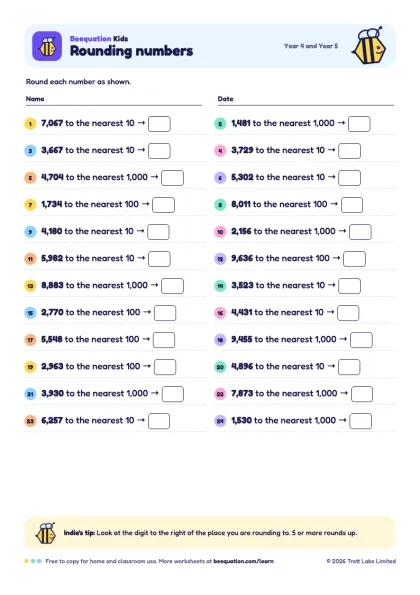 Rounding numbersYear 4, Year 5 · Round to the nearest 10, 100 and 1,000Download PDF
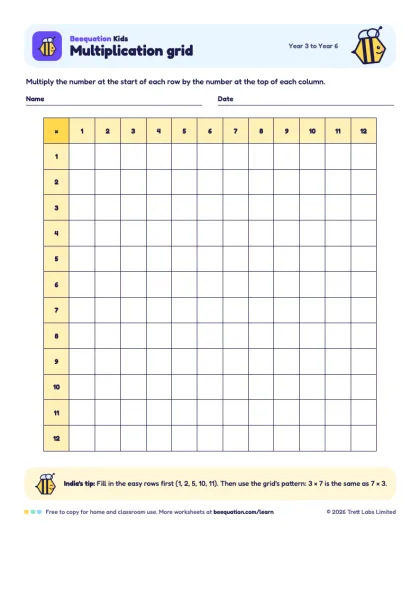 Multiplication gridYear 3, Year 4, Year 5, Year 6 · Fill in the 12 × 12 gridDownload PDF
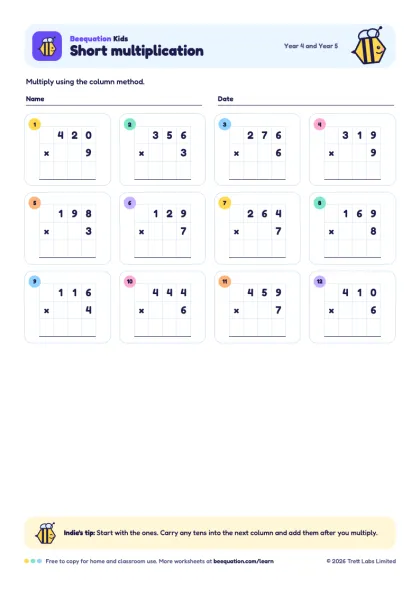 Short multiplicationYear 4, Year 5 · Three-digit by one-digit numbersDownload PDF
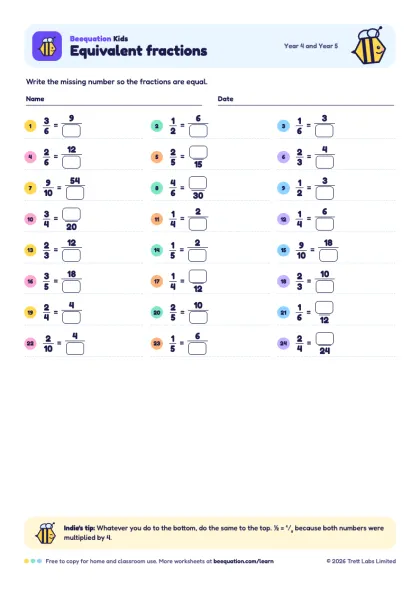 Equivalent fractionsYear 4, Year 5 · Find the missing numberDownload PDF
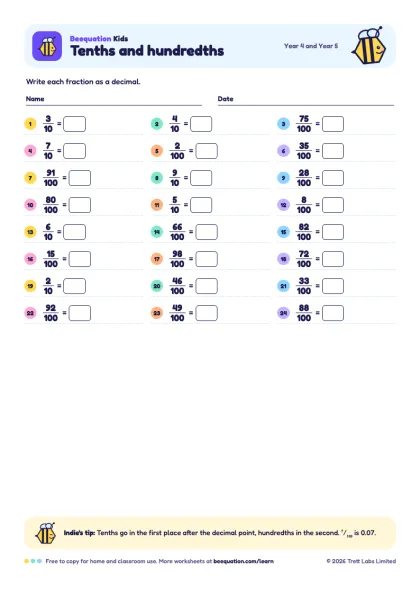 Tenths and hundredthsYear 4, Year 5 · Fractions as decimalsDownload PDF
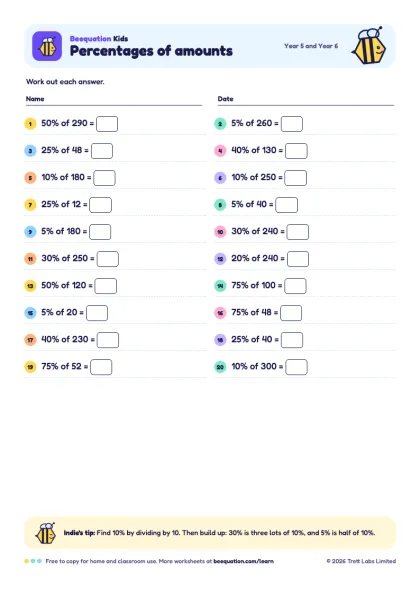 Percentages of amountsYear 5, Year 6 · 10%, 25%, 50% and moreDownload PDF
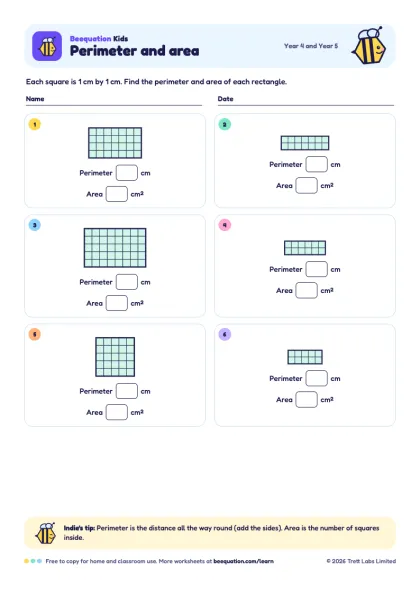 Perimeter and areaYear 4, Year 5 · Rectangles on a centimetre gridDownload PDF
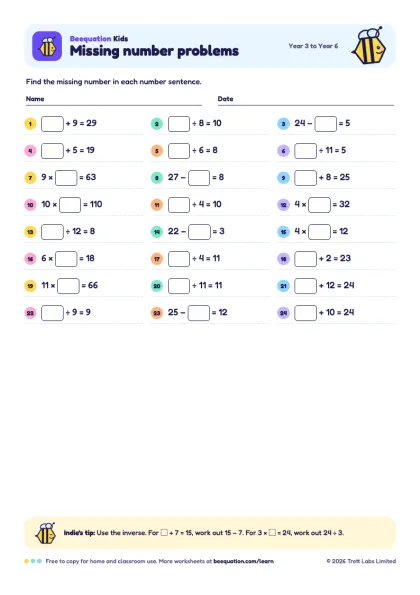 Missing number problemsYear 3, Year 4, Year 5, Year 6 · Find the number in the boxDownload PDF
Quick answers
A whole number with exactly two factors: 1 and itself. The prime numbers up to 20 are 2, 3, 5, 7, 11, 13, 17 and 19. Year 5 children learn these and check whether numbers up to 100 are prime.
Yes. Long multiplication (multiplying by a two-digit number, such as 24 × 36) is introduced in Year 5. Long division comes in Year 6.
In Year 5. They learn that per cent means "out of 100", and link percentages to fractions and decimals, such as ½ = 50% = 0.5.
An angle bigger than a half turn (180°) but smaller than a whole turn (360°). Children learn about them in Year 5, along with acute and obtuse angles.
Practise with Indie
Beequation Kids turns number facts into honeycomb puzzles, with Indie giving a hint when a child is stuck. No ads and no data collected.