Topic guide
Money
Money in primary maths means knowing the coins and notes and what each one is worth, counting amounts, writing them in pounds and pence, and working out costs and change. It brings together counting, place value, adding and subtracting, and later decimals, all in a setting children already care about.
Many children now see far less cash than their parents did, as so much is paid by card or phone. That makes handling real coins at home more valuable, not less.
What children learn, year by year
This follows the National Curriculum in England. US grades are roughly one year behind the UK year number. In Reception, children often meet money through shop role play, but it isn't one of the Early Learning Goals.
| Year | What they learn |
|---|---|
| Year 1 | Recognise all the coins and notes and know what each one is worth. |
| Year 2 | Use the symbols £ and p. Put coins together to make an amount, and find different ways to make the same amount. Add and subtract money in the same unit (all pence or all pounds), including giving change. |
| Year 3 | Add and subtract amounts that use both pounds and pence, and give change, in real-life situations. |
| Year 4 | Estimate, compare and calculate with pounds and pence. Solve money problems with decimals up to two decimal places. |
| Year 5 | Use all four operations (add, subtract, multiply, divide) with money written as decimals, including scaling: 6 tickets at £4.75 each cost £28.50. |
| Year 6 | Solve problems with several steps, and use percentages with money: 20% off £15 is £3 off, so the price becomes £12. |
The big ideas
1. Know the coins and notes
There are eight UK coins: 1p, 2p, 5p, 10p, 20p, 50p, £1 and £2. There are four Bank of England notes: £5, £10, £20 and £50.
Look at the picture again. The 5p is smaller than the 1p, and the 10p is bigger than the 20p. So children can't tell what a coin is worth from its size or colour. They need to read the number on it. Sorting a pile of real coins is the best way to learn them.
2. Count coins starting with the biggest value
Young children often count each coin as 1, so three coins becomes "3p". Show them that one 20p coin is worth the same as twenty 1p coins.
To count a handful of coins, sort them, then start with the coins worth the most and count on. Two 20p coins, a 10p, a 5p and a 2p: "20, 40, 50, 55, 57. That's 57p." This uses counting in 2s, 5s and 10s from counting and place value.
3. Pounds and pence
There are 100 pence in £1. We write amounts of £1 or more with a pound sign and a dot: £3.45 means 3 pounds and 45 pence, which is the same as 345p. The pence part always has two digits, so £2.07 is 2 pounds and 7 pence, while £2.70 is 2 pounds and 70 pence.
Use either £ or p, never both. Write 45p or £0.45, but not £0.45p.
4. Making amounts in different ways
There are lots of ways to make the same amount. 37p could be 20p + 10p + 5p + 2p, or 20p + 10p + 5p + 1p + 1p, or 37 one-penny coins. To use the fewest coins, start with the biggest coin that fits, then the biggest coin that fits what's left, and so on. For 37p that gives 20p, 10p, 5p and 2p: four coins.
Let your child pay at a shop counter with real coins, and ask them to work out the change before the cashier hands it over. If you mostly pay by card, keep a jar of coins at home for a pretend shop with price labels on tins and toys.
5. Giving change: count on
Change is a subtraction, but the easiest way to work it out is to count on from the price to the amount paid, like a shopkeeper. Something costs 64p and you pay with £1:
- 64p to 65p is 1p
- 65p to 70p is 5p
- 70p to £1 is 30p
The change is 1p + 5p + 30p = 36p. The same works with bigger amounts. Something costs £3.72 and you pay with a £5 note: £3.72 to £3.80 is 8p, £3.80 to £4 is 20p, and £4 to £5 is £1. The change is £1.28.
6. Shopping problems and money as decimals
Word problems about shopping usually need two steps: find the total, then find the change. Apples cost 45p each. How much change do you get from £2 for 3 apples? First, 3 × 45p = 135p, which is £1.35. Then count on from £1.35 to £2: that's 65p change.
From Year 4, children treat money as decimals. In the column method, line up the dots: £12.75 + £4.60 = £17.35. A calculator shows £3.50 as 3.5, so children need to know that 3.5 means £3.50, not £3.05.
Common mistakes to look out for
- Bigger coin, more money: thinking a 1p is worth more than a 5p because it's bigger.
- Counting coins, not values: saying a 20p, a 10p and a 5p make "3p".
- Writing amounts wrongly: £3.5 instead of £3.50, £1.5 for one pound five (it's £1.05), or using both symbols, as in £2.50p.
- Mixing pounds and pence: adding £2 and 50p and getting 52p. Change everything into the same unit first: £2 is 200p, so the total is 250p or £2.50.
- Column subtraction slips: taking £3.72 from £5.00 in columns means exchanging across zeros, and that's where mistakes creep in. Counting on is safer.
Five-minute money games for home
- Home shop. Put price labels on a few toys or tins (1p to £1 for younger children, up to £10 for older ones). Take turns being the shopkeeper who gives change.
- Piggy bank count. Tip out a money box, sort the coins and count the total, starting with the biggest coins.
- How many ways? How many different ways can you make 10p? Write them down and see who finds the most.
- Fewest coins. What's the fewest coins you can use to make 48p? (Five: 20p, 20p, 5p, 2p and 1p.)
- Supermarket estimate. Round each item in the trolley to the nearest pound and keep a running total. How close was your estimate to the receipt?
Indie's challengeIndie buys a jar of honey for £2.65 and a pot of pollen for £1.80. She pays with a £5 note. How much change does she get? Show the answer
First find the total: £2.65 + £1.80 = £4.45. Then count on from £4.45 to £5: £4.45 to £4.50 is 5p, and £4.50 to £5 is 50p. Indie gets 55p change.
Free money worksheets
Print these for practice at home or in class. Each one has an answer sheet on the second page.
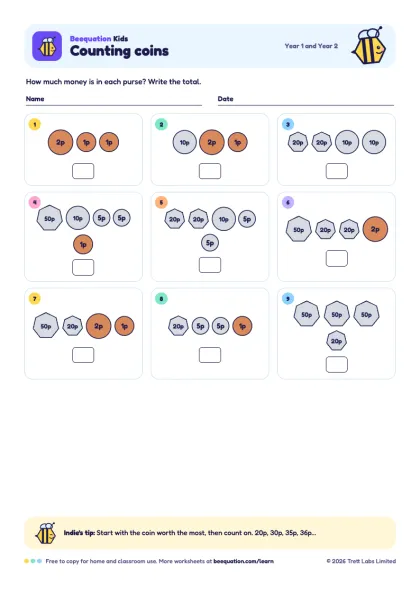 Counting coinsYear 1, Year 2 · Add up UK coinsDownload PDF
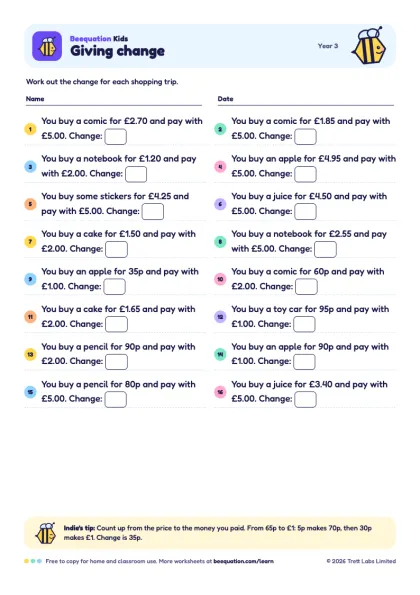 Giving changeYear 3 · Change from £1, £2 and £5Download PDF
Quick answers
By the end of Year 1, all eight coins (1p, 2p, 5p, 10p, 20p, 50p, £1 and £2) and the four notes (£5, £10, £20 and £50), and what each one is worth.
Use a pound sign and a dot, with two digits for the pence: £4.60. Or write everything in pence: 460p. Never use both symbols together.
Count on from the price to the amount paid, in friendly jumps: to the next 10p, then to the next pound, then on to the amount paid. Add up the jumps.
Most start writing amounts with pounds and pence together, like £3.45, in Year 3. They calculate with money as decimals from Year 4, using all four operations by Year 5.
Practise with Indie
Beequation Kids turns number facts into honeycomb puzzles, with Indie giving a hint when a child is stuck. No ads and no data collected.