Learn › Year groups › Year 4
Year group guide
Year 4 maths: what your child learns (age 8 to 9)
Year 4 is for children aged 8 to 9, roughly the same as Grade 3 in the US. It's the second year of Key Stage 2. This is the big times tables year: by the end of it, children are expected to know every multiplication fact up to 12 × 12, and in June they take the national Multiplication Tables Check.
What Year 4 children are working on
Numbers grow to four digits (thousands), and children meet negative numbers for the first time by counting back past zero. Fractions lead on to decimals: tenths and hundredths written as 0.3 and 0.07. Children also find area by counting squares, plot points using coordinates and use the column methods with bigger numbers.
Most of all, Year 4 is about fluency with times tables. Knowing them quickly frees up children's thinking for everything that follows in Year 5 and Year 6.
The Year 4 maths curriculum
This follows the National Curriculum in England. Each heading links to a full guide to that topic.
Number and place value
- Count in multiples of 6, 7, 9, 25 and 1,000.
- Find 1,000 more or less than a number: 1,000 more than 4,768 is 5,768.
- Count backwards through zero to negative numbers: 2, 1, 0, −1, −2, −3.
- Know the value of each digit in a four-digit number (thousands, hundreds, tens and ones), and order and compare numbers beyond 1,000.
- Round any number to the nearest 10, 100 or 1,000: 4,768 rounds to 4,770, 4,800 and 5,000.
- Read Roman numerals to 100 (I to C), such as XLVII = 47, and learn that the number system changed over time to include zero and place value.
Addition and subtraction
- Add and subtract numbers with up to four digits using the column method: 5,000 − 1,236 = 3,764.
- Estimate first, and use the inverse to check: 3,764 + 1,236 = 5,000.
- Solve two-step problems in real-life contexts.
Multiplication and division
- Recall multiplication and division facts for all the times tables up to 12 × 12.
- Multiply and divide mentally using known facts, including multiplying by 0 and 1, dividing by 1, and multiplying three numbers: 2 × 6 × 5 = 2 × 5 × 6 = 10 × 6 = 60.
- Find factor pairs: the factor pairs of 12 are 1 × 12, 2 × 6 and 3 × 4.
- Multiply two-digit and three-digit numbers by a one-digit number using short multiplication: 243 × 6 = 1,458. Many schools also start short division with exact answers.
- Solve problems by splitting numbers up: 39 × 7 = 30 × 7 + 9 × 7 = 210 + 63 = 273.
Fractions
- Show families of equivalent fractions with diagrams: ½ = ²⁄₄ = ³⁄₆ = ⁴⁄₈.
- Count up and down in hundredths, and know that hundredths come from dividing something into 100 equal parts, or a tenth into 10.
- Find fractions of amounts, including non-unit fractions: ¾ of 20 = 15.
- Add and subtract fractions with the same denominator: ³⁄₁₀ + ⁴⁄₁₀ = ⁷⁄₁₀.
Decimals
- Write tenths and hundredths as decimals: ³⁄₁₀ = 0.3 and ⁷⁄₁₀₀ = 0.07.
- Know that ¼ = 0.25, ½ = 0.5 and ¾ = 0.75.
- Divide one-digit and two-digit numbers by 10 and 100: 35 ÷ 10 = 3.5 and 35 ÷ 100 = 0.35.
- Round a number with one decimal place to the nearest whole number: 3.6 rounds to 4.
- Compare numbers with up to two decimal places, and solve money and measure problems with decimals.
Measurement: length, mass, capacity, perimeter, area
- Convert between units, such as kilometres and metres (3 km = 3,000 m).
- Measure and work out the perimeter of shapes made of rectangles, in cm and m.
- Find the area of a shape by counting squares.
- Estimate, compare and calculate measures, including money in pounds and pence.
Measurement: time
- Read, write and convert times between analogue and digital 12-hour and 24-hour clocks: quarter to four in the afternoon is 3:45 p.m., or 15:45.
- Convert hours to minutes, minutes to seconds, years to months and weeks to days.
Geometry: properties of shapes
- Compare and sort shapes, including types of triangle (such as isosceles and equilateral) and quadrilateral (such as square, rectangle, rhombus and trapezium).
- Recognise acute angles (smaller than a right angle) and obtuse angles (between one and two right angles), and order angles by size.
- Find lines of symmetry in 2D shapes, even when they are turned, and complete a symmetrical picture.
Geometry: position and direction
- Describe positions on a grid using coordinates such as (3, 5): 3 across, then 5 up.
- Describe movements as translations, such as "2 squares left and 3 squares up".
- Plot points and join them to draw a shape.
Statistics
- Read and draw bar charts and time graphs, such as the temperature over a day.
- Solve problems about totals, differences and comparisons using bar charts, pictograms, tables and other graphs.
By the end of Year 4, most children can…
- recall all the times tables up to 12 × 12, and the division facts that go with them
- read, write, order and round numbers with four digits
- count back past zero into negative numbers
- add and subtract four-digit numbers using the column method
- multiply a three-digit number by a one-digit number, such as 243 × 6 = 1,458
- find fractions of amounts, such as ¾ of 20 = 15, and spot equivalent fractions
- write tenths and hundredths as decimals, and know ¼ = 0.25, ½ = 0.5 and ¾ = 0.75
- find area by counting squares and work out perimeters
- change between 12-hour and 24-hour times
- name acute and obtuse angles, and plot points using coordinates
Key vocabulary
| Word | What it means |
|---|---|
| Thousands | The fourth place value column: 4,768 has 4 thousands. |
| Negative number | A number less than zero, such as −3. Think of temperatures below freezing. |
| Round | Find the nearest ten, hundred or thousand. 5 or more rounds up. |
| Factor | A number that divides into another exactly: 3 is a factor of 12. |
| Short multiplication | A written method for multiplying by a one-digit number, working from the ones column. |
| Equivalent fractions | Fractions that are worth the same, like ½ and ⁴⁄₈. |
| Decimal, decimal point | A way of writing tenths and hundredths: 0.25 is 2 tenths and 5 hundredths. |
| Area | The amount of flat space a shape covers, counted in squares. |
| Acute, obtuse | An angle smaller than a right angle, and an angle between a right angle and a straight line. |
| Coordinates | A pair of numbers that give a position on a grid: across first, then up. |
The Multiplication Tables Check
In June of Year 4, every child in England takes the Multiplication Tables Check. It's done on a screen and has 25 questions, with 6 seconds to answer each one. Questions cover the times tables up to 12 × 12. There is no pass mark: it's there to help schools see which tables children know well and which need more practice.
Quick recall matters more than clever methods here, because 6 seconds isn't long enough to count up. Short, regular practice works best. Our times tables practice guide has games and ideas.
How to help at home
- A few times tables a day. Five minutes in the car or at breakfast is better than an hour at the weekend. Focus on the facts your child finds tricky.
- Practise the division facts too. If 7 × 8 = 56, then 56 ÷ 8 = 7 and 56 ÷ 7 = 8.
- Look at money as decimals. £3.45 means 3 pounds and 45 pence, and 45p is 0.45 of a pound.
- Talk about temperatures. A weather app is a great way to see negative numbers: how much warmer is 4 °C than −2 °C? (6 degrees.)
- Use the 24-hour clock. Read train times, cinema times and the oven clock together.
- Play battleships. It's coordinates practice in disguise.
Use the facts your child already knows to work out the tricky ones. 6 × 7 is double 3 × 7, so double 21 is 42. 9 × 8 is 10 × 8 take away 8, so 80 − 8 = 72. Once a fact has been worked out a few times, it starts to stick, and then it can be recalled quickly in the Multiplication Tables Check.
Indie's challengeIndie's honeycomb has 7 rows with 12 cells in each row. She has filled ¾ of the cells with honey. How many cells are full? Show the answer
Free Year 4 maths worksheets
Print these for practice at home or in class. Each one has an answer sheet on the second page.
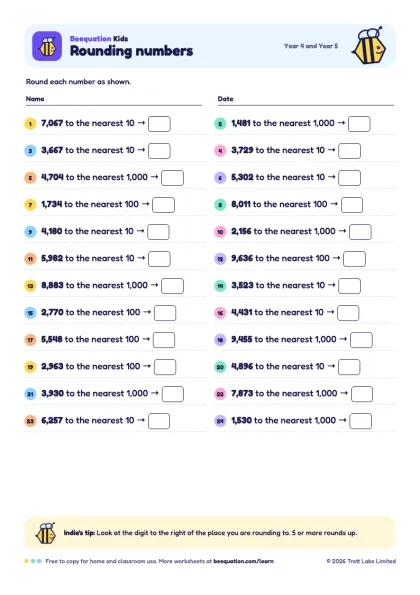 Rounding numbersYear 4, Year 5 · Round to the nearest 10, 100 and 1,000Download PDF
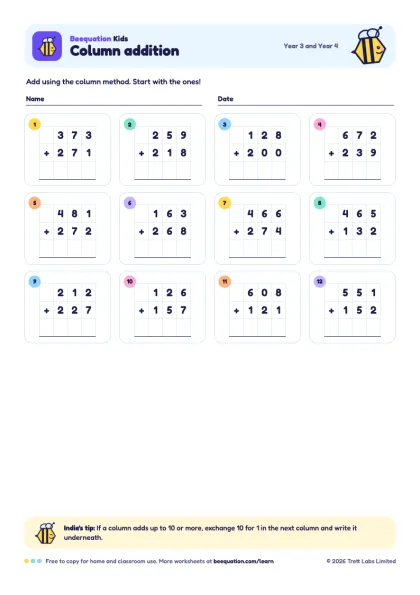 Column additionYear 3, Year 4 · Three-digit numbers, with exchangingDownload PDF
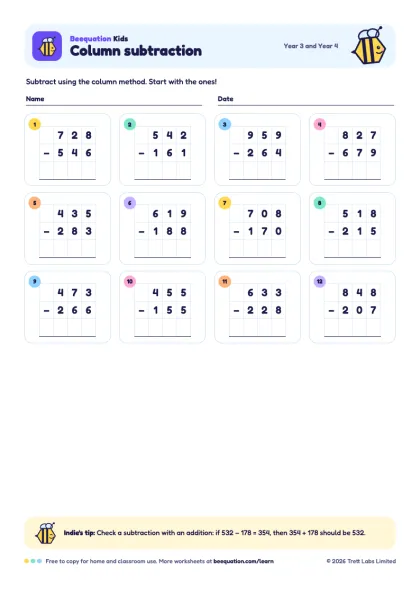 Column subtractionYear 3, Year 4 · Three-digit numbers, with exchangingDownload PDF
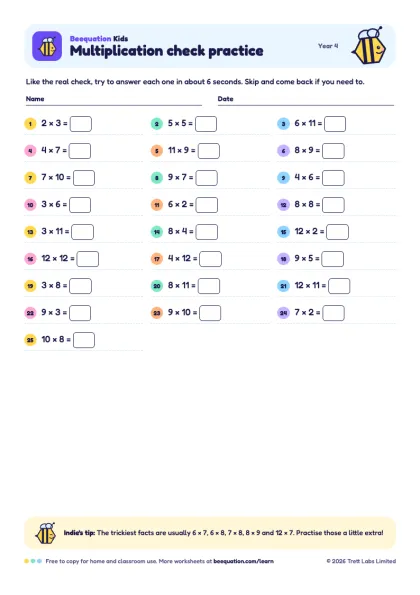 Multiplication check practiceYear 4 · 25 questions up to 12 × 12Download PDF
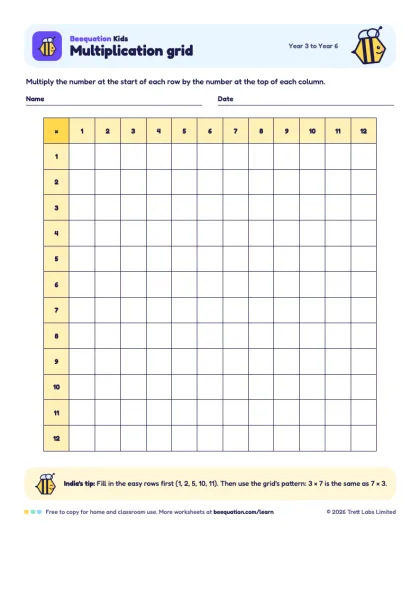 Multiplication gridYear 3, Year 4, Year 5, Year 6 · Fill in the 12 × 12 gridDownload PDF
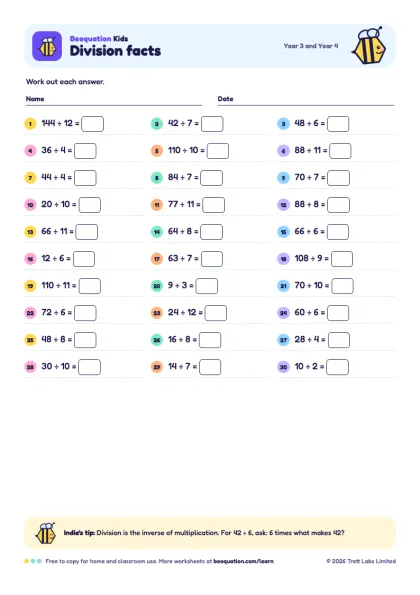 Division factsYear 3, Year 4 · Using times tables to divideDownload PDF
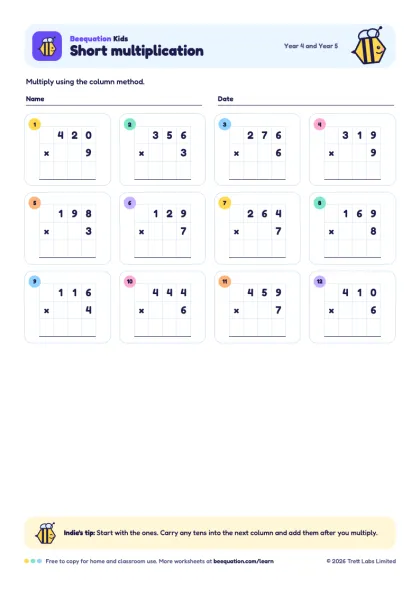 Short multiplicationYear 4, Year 5 · Three-digit by one-digit numbersDownload PDF
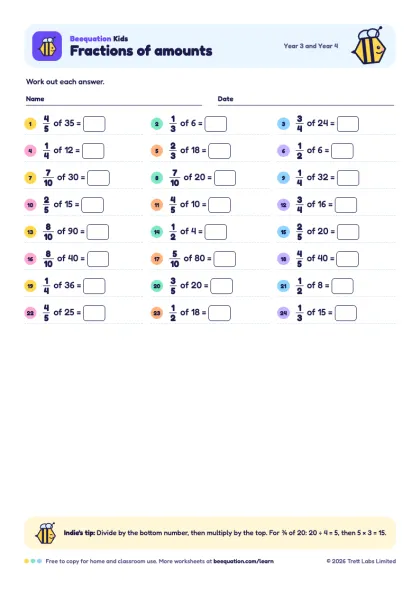 Fractions of amountsYear 3, Year 4 · Like ½ of 12 and ¾ of 20Download PDF
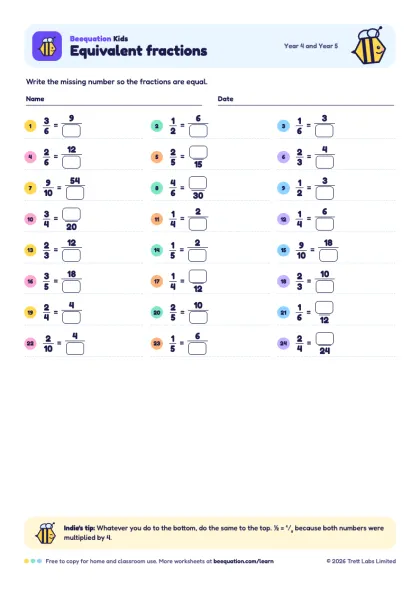 Equivalent fractionsYear 4, Year 5 · Find the missing numberDownload PDF
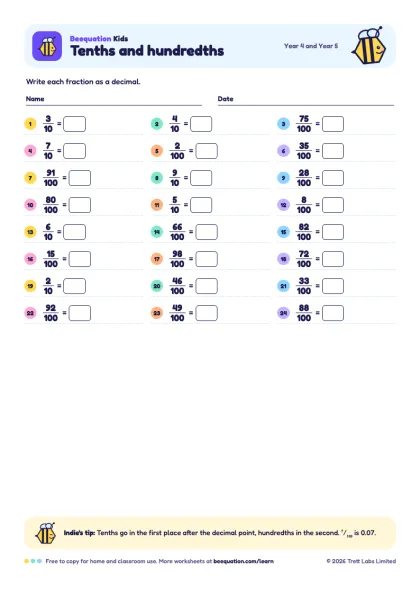 Tenths and hundredthsYear 4, Year 5 · Fractions as decimalsDownload PDF
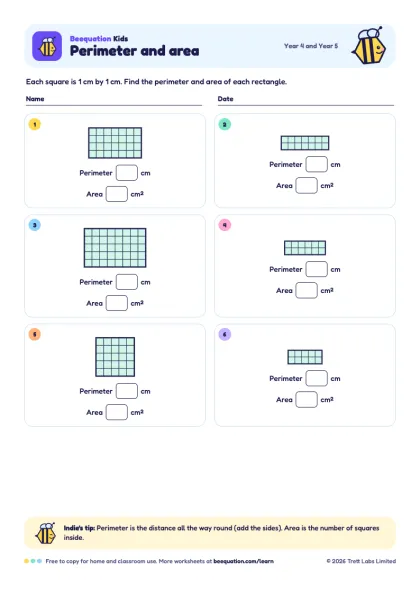 Perimeter and areaYear 4, Year 5 · Rectangles on a centimetre gridDownload PDF
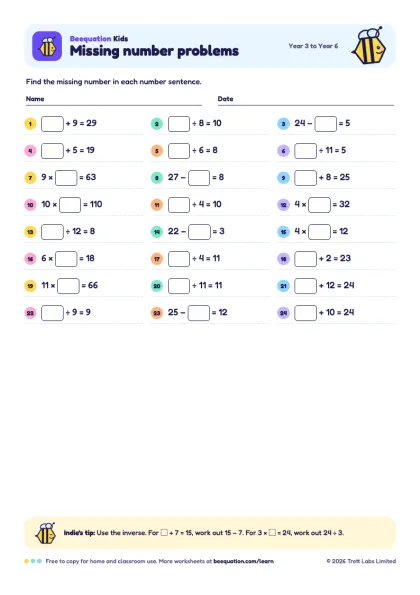 Missing number problemsYear 3, Year 4, Year 5, Year 6 · Find the number in the boxDownload PDF
Quick answers
In June of Year 4. It's an on-screen check of 25 times tables questions, with 6 seconds for each one, covering facts up to 12 × 12.
No. There is no pass mark. The results help the school see how well children know their times tables and where they need more practice.
All of them, up to 12 × 12, including the matching division facts. The 6, 7, 9, 11 and 12 times tables are the new ones this year, built on the 2, 3, 4, 5, 8 and 10 times tables from Years 2 and 3.
Yes. They learn to write tenths and hundredths as decimals (0.1 and 0.01), divide by 10 and 100, and know that ¼ = 0.25, ½ = 0.5 and ¾ = 0.75.
Practise with Indie
Beequation Kids turns number facts into honeycomb puzzles, with Indie giving a hint when a child is stuck. No ads and no data collected.