Topic guide
Measurement
Measurement is finding out how big something is, using numbers and units. In primary school that means length (how long, tall or far), mass (how heavy), capacity and volume (how much something holds or takes up) and temperature (how hot or cold). Later it includes perimeter (the distance around a shape), area (the space inside it) and the volume of solid shapes.
Children start by comparing ("which is longer?"), then measure with everyday things like hand spans or cubes, and then move on to standard units such as centimetres, kilograms and litres. Time and money are measures too, and have their own pages.
What children learn, year by year
This follows the National Curriculum in England and the EYFS framework for Reception. US grades are roughly one year behind the UK year number.
| Year | What they learn |
|---|---|
| Reception | Compare length, weight and capacity: which is longer, which is heavier, which holds more. |
| Year 1 | Compare and describe lengths, heights, mass and capacity using words like longer, shorter, heavier, lighter, full, empty and half full. Begin to measure and record, often with non-standard units like cubes. |
| Year 2 | Use standard units: metres and centimetres, kilograms and grams, litres and millilitres, and degrees Celsius (°C). Measure with rulers, scales, measuring jugs and thermometers. Compare measurements using <, > and =. |
| Year 3 | Measure, compare, add and subtract lengths (including millimetres), masses and capacities. Measure the perimeter of simple 2D shapes. |
| Year 4 | Convert between units, such as kilometres and metres. Work out the perimeter of rectangles and other shapes made of straight lines and right angles. Find area by counting squares. |
| Year 5 | Convert between metric units. Know rough imperial equivalents (inches, pounds, pints). Calculate the area of rectangles in cm² and m², and estimate the area of irregular shapes. Estimate volume with 1 cm³ cubes. Solve measurement problems with decimals. |
| Year 6 | Convert using up to three decimal places (1.25 km = 1250 m). Convert between miles and kilometres. Find the area of triangles and parallelograms. Calculate the volume of cubes and cuboids. See that shapes with the same area can have different perimeters. |
The big ideas
1. Compare first, then measure
Measuring starts with comparing two things directly: stand back to back to see who is taller, or hold two bags to feel which is heavier. Next, children measure with non-standard units, such as how many cubes long a book is or how many cups of water fill a jug.
This stage has a purpose. If you measure a table in your hand spans and your child measures it in theirs, you get different answers. That's why we need standard units that are the same for everyone.
2. Know the units and how they fit together
Metric units link by 10, 100 and 1000, so converting is multiplying or dividing by those numbers. The start of the word gives a clue: kilo means a thousand, centi means a hundredth, and milli means a thousandth.
| Measure | Units | Feels like |
|---|---|---|
| Length | 10 mm = 1 cm, 100 cm = 1 m, 1000 m = 1 km | 1 cm is about the width of a fingernail |
| Mass | 1000 g = 1 kg | 1 kg is a bag of sugar |
| Capacity | 1000 ml = 1 litre | 1 litre is a big bottle of water; a teaspoon is 5 ml |
| Temperature | degrees Celsius (°C) | Water freezes at 0 °C and boils at 100 °C |
Examples: 2.5 kg = 2500 g, 350 cm = 3.5 m, and 1.25 litres = 1250 ml. Temperatures below zero, like −3 °C on a frosty morning, link to negative numbers in Years 5 and 6.
3. Reading scales: what is each mark worth?
Most scales don't label every mark. Before reading one, find two labelled numbers, count the gaps between them, and work out what each gap is worth. On kitchen scales marked 0, 1 kg and 2 kg with 4 gaps between each, every gap is 1000 g ÷ 4 = 250 g.
On a ruler, line the object up with 0, not with the end of the ruler. Many rulers have a small gap before the 0.
Cook or bake together. Weighing 200 g of flour, measuring 150 ml of milk and setting the oven to 180 °C is real measuring with a reason, and your child gets to eat the results.
4. Perimeter and area
Perimeter is the distance all the way around the outside of a shape. Add up the lengths of all the sides. It is a length, so it's measured in cm or m.
Area is how much flat space a shape covers. In Year 4, children count squares. By Year 5, they notice the shortcut for a rectangle: length × width. Area is measured in square units, like cm² (square centimetres) and m².
In Year 6, children discover that shapes with the same area can have different perimeters. A 6 cm by 4 cm rectangle, an 8 cm by 3 cm rectangle and a 12 cm by 2 cm rectangle all have an area of 24 cm², but their perimeters are 20 cm, 22 cm and 28 cm. They also learn that a triangle's area is half of base × height: a triangle with a base of 8 cm and a height of 5 cm has an area of 20 cm².
5. Volume and capacity
Capacity is how much a container can hold. Volume is how much space something takes up. Children build cuboids from 1 cm cubes and count them, and in Year 6 they use the shortcut length × width × height. A cuboid 5 cm long, 3 cm wide and 2 cm high has a volume of 5 × 3 × 2 = 30 cm³ (cubic centimetres). A neat link: 1 cm³ holds exactly 1 ml.
6. Imperial units
The UK still uses some older imperial units: miles on road signs, pints of milk, and feet and inches for people's height. In Year 5, children learn rough equivalents, and in Year 6 they convert between miles and kilometres.
- 1 inch is about 2.5 cm, and 1 foot is about 30 cm
- 1 kg is about 2.2 pounds (lb)
- 1 pint is about 570 ml, a little more than half a litre
- 5 miles is about 8 km
Common mistakes to look out for
- Starting at 1 (or at the end of the ruler): always line up with 0.
- Thinking every mark is 1: work out what each mark is worth first.
- Mixing up perimeter and area: perimeter goes around the edge; area covers the inside. Their units are different too: cm and cm².
- Adding different units: 1 m + 20 cm is not 21. Change to the same unit first: 100 cm + 20 cm = 120 cm, or 1.2 m.
- Decimal conversions: 1.5 m is 1 m 50 cm, not 1 m 5 cm, and 2.3 kg is 2300 g, not 230 g.
- Tall means more: young children often think a tall, thin glass holds more than a short, wide one. Pour the water from one to the other and see.
Five-minute measuring games for home
- Guess, then measure. How many of your hand spans long is the kitchen table? Guess, measure, then check with a tape measure in centimetres.
- Heavier or lighter? Hold two things from the shopping bag and guess which is heavier. Check on the kitchen scales.
- Container line-up. Put cups, mugs and bottles in order from holds least to holds most, then test with water in the bath or sink.
- Squares design. On squared paper, draw as many different shapes as you can with an area of 12 squares. Which one has the longest perimeter?
Indie's challengeIndie's honeycomb frame is a rectangle 9 cm long and 5 cm wide. How long a ribbon does she need to go all the way around it, and how many 1 cm squares would cover it? Show the answer
The ribbon goes around the edge, so it's the perimeter: 9 + 5 + 9 + 5 = 28 cm. Covering it is the area: 9 × 5 = 45 squares, which is 45 cm².
Free measurement worksheets
Print these for practice at home or in class. Each one has an answer sheet on the second page.
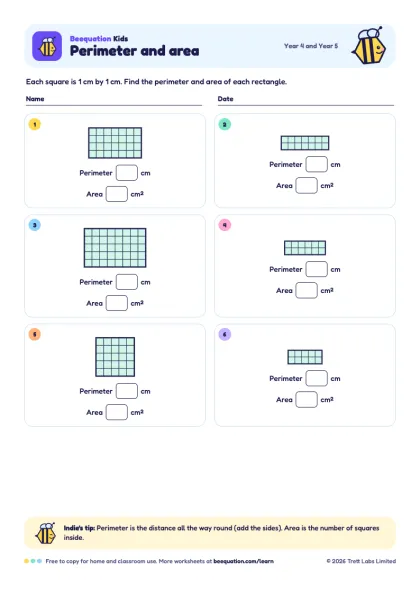 Perimeter and areaYear 4, Year 5 · Rectangles on a centimetre gridDownload PDF
Quick answers
Perimeter is the distance around the outside of a shape, measured in units like cm. Area is the space inside it, measured in square units like cm². A 6 cm by 4 cm rectangle has a perimeter of 20 cm and an area of 24 cm².
At primary school the two words are often used to mean the same thing, measured in grams and kilograms. Strictly, mass is how much stuff something is made of and weight is the pull of gravity on it, which children meet in science later on.
Multiply or divide by 10, 100 or 1000. To go to a smaller unit (m to cm), multiply: 3 m = 300 cm. To go to a bigger unit (g to kg), divide: 4500 g = 4.5 kg.
Yes, a little. In Year 5 they learn rough equivalents for inches, pounds and pints, and in Year 6 they convert between miles and kilometres.
Practise with Indie
Beequation Kids turns number facts into honeycomb puzzles, with Indie giving a hint when a child is stuck. No ads and no data collected.