Learn › Topics › Multiplication and division
Topic guide
Multiplication and division
Multiplication is a quick way of adding equal groups: 3 × 4 means 3 groups of 4, which is 4 + 4 + 4 = 12. Division is the opposite. It splits an amount into equal groups: 12 ÷ 3 = 4. Children learn the two together, starting with sharing sweets and counting in 2s, then times tables, and finally written methods for big numbers.
What children learn, year by year
This follows the EYFS framework for Reception and the National Curriculum in England from Year 1. US grades are roughly one year behind the UK year number.
| Year | What they learn |
|---|---|
| Reception | Doubles of numbers to 5. Sharing things out fairly. Spotting odd and even numbers within 10. |
| Year 1 | Count in 2s, 5s and 10s. Solve simple grouping and sharing problems with objects, pictures and arrays, with help from the teacher. |
| Year 2 | The 2, 5 and 10 times tables, and the division facts that go with them. Odd and even numbers. Write sums with ×, ÷ and =. Know that multiplying can be done in any order but dividing cannot. |
| Year 3 | The 3, 4 and 8 times tables. Multiply a two-digit number by a one-digit number, first mentally and then on paper. |
| Year 4 | All the times tables up to 12 × 12, checked by the Multiplication Tables Check in June. Multiplying by 0 and 1, multiplying three numbers, factor pairs. Short multiplication of two- and three-digit numbers by a one-digit number. |
| Year 5 | Factors, multiples and prime numbers (and know the primes up to 19). Square and cube numbers. Long multiplication by a two-digit number. Short division of numbers up to 4 digits by a one-digit number, with remainders. Multiply and divide by 10, 100 and 1,000. |
| Year 6 | Long multiplication (up to 4 digits by 2 digits). Long division by a two-digit number, with remainders written as whole numbers, fractions or decimals, or rounded to fit the question. Common factors and common multiples. The order of operations. |
The big ideas
1. Multiplying is equal groups, and order doesn't matter
Arrays (things laid out in rows and columns) are the most useful picture in this topic. Turn the array above on its side and 3 rows of 4 becomes 4 rows of 3, still with 12 dots. So 3 × 4 = 4 × 3, and learning one fact gives you two.
2. Division can mean sharing or grouping
12 ÷ 3 can be read in two ways. Sharing: share 12 sweets between 3 children, and each child gets 4. Grouping: put 12 sweets into bags of 3, and you fill 4 bags. Both give 4. Division is the inverse of multiplication, so the fastest way to work out 56 ÷ 8 is to ask "8 times what makes 56?". The answer is 7.
3. Times tables, year by year
Children learn the 2, 5 and 10 times tables in Year 2, the 3, 4 and 8 times tables in Year 3, and all the rest up to 12 × 12 by the end of Year 4. In June of Year 4 they take the Multiplication Tables Check: 25 questions on screen, with 6 seconds to answer each one, covering tables up to 12 × 12. There is no pass mark. Our times tables practice guide has ideas for getting ready.
Children can use facts they know to work out ones they don't. The 4 times table is double the 2 times table. The 8 times table is double the 4. 9 × 7 is 10 × 7 take away one 7: 70 − 7 = 63.
Five minutes of times tables every day does more than one long session a week. Pick two or three facts your child finds hard, such as 7 × 8 = 56 and 6 × 8 = 48, and come back to them often, in the car, in the bath or on the way to school. Saying the division facts too (56 ÷ 8 = 7) doubles the value of each one.
4. Factors, multiples and primes
The factors of a number divide into it exactly. The factors of 12 are 1, 2, 3, 4, 6 and 12, and they come in pairs: 1 × 12, 2 × 6 and 3 × 4. The multiples of a number are its times table, carrying on forever: the multiples of 6 are 6, 12, 18, 24 and so on. A prime number has exactly two factors, 1 and itself. The primes up to 19 are 2, 3, 5, 7, 11, 13, 17 and 19. The number 1 is not prime, because it has only one factor.
5. Written methods for bigger numbers
Short multiplication (Year 4) multiplies by a one-digit number, starting with the ones. For 243 × 6: 3 × 6 = 18, write 8 and carry 1 ten. 4 × 6 = 24 tens, plus the 1 carried makes 25, so write 5 and carry 2 hundreds. 2 × 6 = 12 hundreds, plus 2 makes 14. The answer is 1,458.
Long multiplication (Years 5 and 6) multiplies by a two-digit number one digit at a time, then adds. For 34 × 26: 34 × 6 = 204, and 34 × 20 = 680. Then 204 + 680 = 884. The 0 at the end of 680 matters: it is there because you are multiplying by 2 tens, not 2.
Short division is often called the "bus stop" method, because of its shape:
Long division (Year 6) is the same idea for two-digit divisors, with the working written out underneath. For 435 ÷ 12: 12 goes into 43 three times (36), leaving 7. Bring down the 5 to make 75. 12 goes into 75 six times (72), leaving 3. So 435 ÷ 12 = 36 remainder 3.
6. Remainders depend on the question
That remainder of 3 can be written in different ways: 36 r 3, or 36¼ (because 3 out of 12 is ¼), or 36.25. In word problems, children decide what the remainder means. If 30 children go on a trip in minibuses that seat 8, then 30 ÷ 8 = 3 r 6, so you need 4 minibuses, not 3. If cakes cost £3 and you have £10, you can buy 3, and the £1 left over is no use.
Common mistakes to look out for
- "Add a zero" to multiply by 10: it works for 25 × 10 = 250 but not for 2.5 × 10, which is 25, not 2.50. The digits move one place to the left; the zero fills the empty ones column.
- Dividing the wrong way round: 12 ÷ 3 and 3 ÷ 12 are different. Ask "what is being shared, and into how many groups?"
- Losing the placeholder in long multiplication: writing 34 × 20 as 68 instead of 680, which makes 34 × 26 come out as 272 instead of 884.
- Remainder too big: writing 30 ÷ 8 = 2 r 14. The remainder must always be smaller than the number you are dividing by.
Five-minute times tables games for home
- Array hunt. Find arrays around the house: an egg box is 2 rows of 6, so 2 × 6 = 12. What multiplication facts can you spot?
- Catch and count. Throw a ball back and forth, counting up in 3s (or any table) with each catch. Then count back down.
- Fair shares. Share out grapes, pasta or coins between family members. Is there anything left over? That's the remainder.
- Times table snap. Write questions on some cards (7 × 8) and answers on others (56). Turn them over and match them.
Indie's challengeIndie baked 87 honey cakes and packs them into boxes of 6. How many boxes can she fill, and how many boxes does she need so that every cake has a box? Show the answer
87 ÷ 6 = 14 remainder 3, because 14 × 6 = 84 and 87 − 84 = 3. So Indie can fill 14 boxes, with 3 cakes left over. To pack every cake she needs 15 boxes, and the last box has only 3 cakes in it.
Free multiplication and division worksheets
Print these for practice at home or in class. Each one has an answer sheet on the second page.
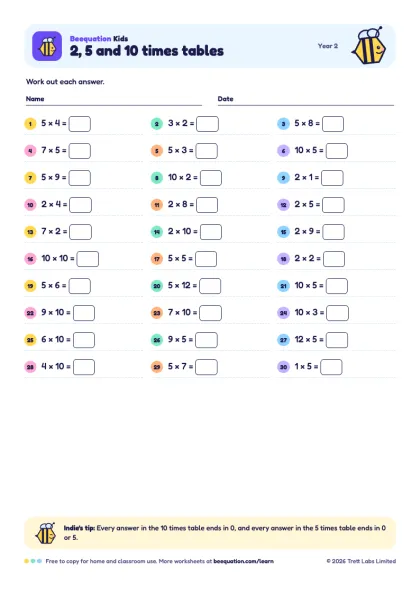 2, 5 and 10 times tablesYear 2 · Mixed questionsDownload PDF
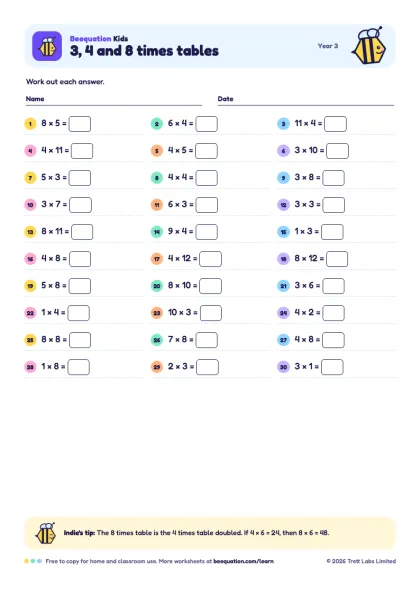 3, 4 and 8 times tablesYear 3 · Mixed questionsDownload PDF
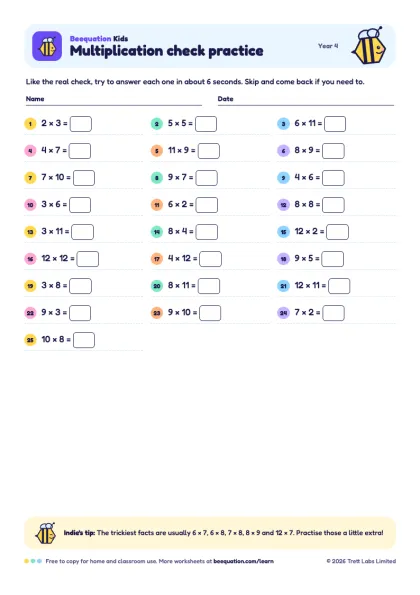 Multiplication check practiceYear 4 · 25 questions up to 12 × 12Download PDF
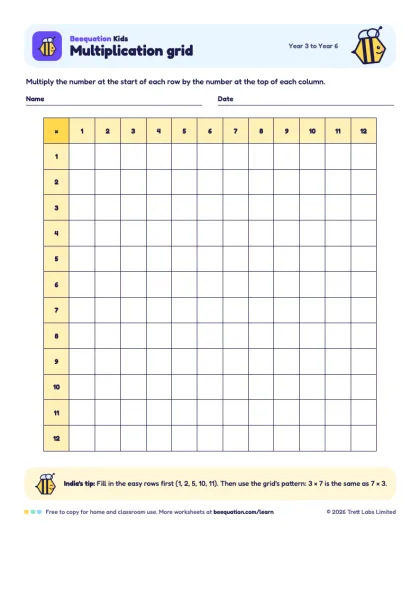 Multiplication gridYear 3, Year 4, Year 5, Year 6 · Fill in the 12 × 12 gridDownload PDF
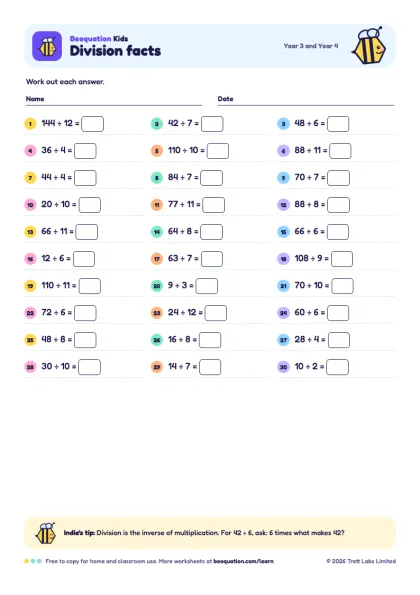 Division factsYear 3, Year 4 · Using times tables to divideDownload PDF
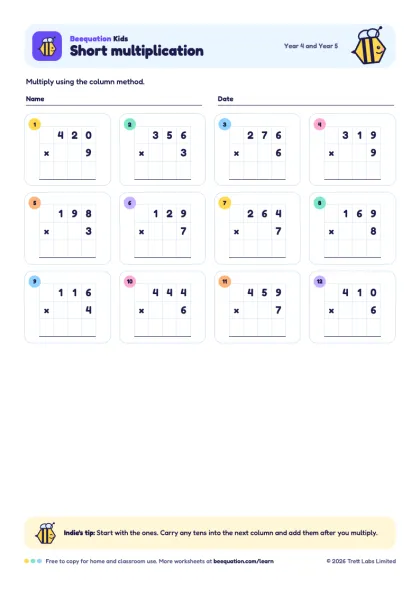 Short multiplicationYear 4, Year 5 · Three-digit by one-digit numbersDownload PDF
Quick answers
An on-screen check taken in June of Year 4. It has 25 questions on times tables up to 12 × 12, with 6 seconds for each one. There is no pass mark.
The nickname for short division, because the divisor waits outside a shape that looks like a bus shelter, with the number being divided underneath and the answer on top.
No. A prime number has exactly two factors, 1 and itself. The number 1 has only one factor, so it is not prime. The smallest prime number is 2, which is also the only even prime.
Practise with Indie
Beequation Kids turns number facts into honeycomb puzzles, with Indie giving a hint when a child is stuck. No ads and no data collected.