Topic guide
Mental maths
Mental maths means working out calculations in your head, sometimes with a quick jotting to keep track. It has two parts. Rapid recall is knowing facts by heart, like 7 + 3 = 10 or 6 × 8 = 48. Mental strategies are the ways of using those facts to work out ones you don't know: if 6 × 8 = 48, then 60 × 8 = 480.
It matters because almost every other part of maths leans on it. A child who knows their number bonds and times tables has room in their head for the new idea being taught, instead of spending all their effort on counting. Mental maths is also the maths grown-ups use every day: checking a bill, working out change, judging whether an answer looks right.
This page is the overview. These three guides go into the detail:
What children learn, year by year
This follows the National Curriculum in England (and the EYFS framework for Reception). US grades are roughly one year behind the UK year number.
| Year | What they learn |
|---|---|
| Reception | See how many are in a small group without counting (called subitising), up to 5. Number bonds to 5 and some to 10, including doubles. |
| Year 1 | Number bonds and the matching subtraction facts within 20. Count on from the bigger number. Count in 2s, 5s and 10s. Begin doubling. |
| Year 2 | Know addition and subtraction facts to 20 fluently and use them for facts to 100 (3 + 4 = 7, so 30 + 40 = 70). Add and subtract a two-digit number and ones, a two-digit number and tens, and two two-digit numbers. Add three one-digit numbers. The 2, 5 and 10 times tables. |
| Year 3 | Add and subtract a three-digit number and ones, tens or hundreds in their head. The 3, 4 and 8 times tables. Two-digit times one-digit, first mentally and then on paper. |
| Year 4 | All the times tables up to 12 × 12, ready for the Multiplication Tables Check in June. Multiply three numbers together. Use known facts to work out new ones. |
| Year 5 | Add, subtract, multiply and divide larger numbers mentally. Multiply and divide by 10, 100 and 1000, including decimals. Square numbers, and prime numbers up to 19. |
| Year 6 | Mental calculations with mixed operations and large numbers. Use estimation to check answers. The Key Stage 2 SATs arithmetic paper in May rewards quick, accurate mental methods. |
The big ideas
1. Know some facts, work out the rest
Nobody memorises every sum. Children learn a small set of facts by heart, then derive new ones from them. Knowing 8 + 2 = 10 gives you 80 + 20 = 100, 800 + 200 = 1000 and 18 + 2 = 20. Knowing 7 × 8 = 56 gives you 56 ÷ 8 = 7, 70 × 8 = 560 and 7 × 9 = 56 + 7 = 63. The more facts are secure, the more new ones are within reach.
2. A handful of strategies does most of the work
These are the methods your child is likely to meet at school. Our mental maths strategies guide explains each one step by step.
- Bridging through 10: 7 + 6 = 7 + 3 + 3 = 13.
- Partitioning: 34 + 25 = 30 + 20 and 4 + 5, which is 50 + 9 = 59.
- Near doubles: 15 + 16 is double 15 plus 1, which is 31.
- Round and adjust: 64 + 19 = 64 + 20 − 1 = 83.
- Counting up to subtract: 83 − 57, shown on the number line below.
- Doubling and halving: 24 × 4 is double 24 (48), then double again (96).
3. Mental and written methods work together
From Year 3 children learn written column methods for numbers too big to hold in their heads. Written methods don't replace mental maths. Every column in a column sum is a mental fact (6 + 7 = 13, carry the 1), and the best habit is to ask first: "can I do this in my head?". For 3005 − 2998, the column method means exchanging across two zeros, which is where mistakes creep in. Counting up from 2998 gives 2 to reach 3000, then 5 more: the answer is 7. For 4826 + 3957 a written method makes sense, and mental maths checks it: about 4800 + 4000 = 8800, so the exact answer, 8783, looks right.
Ask "how did you work that out?" more often than "what's the answer?". Talking through a method helps it stick, and it shows you whether your child counted in ones or used a fact they know. If they used a different method from yours and it works, say so. There is usually more than one good way.
4. Accurate first, then quick
Speed comes from secure facts, not from rushing. Let your child use fingers, objects or a jotting while a fact is new, and practise little and often until they no longer need them. Timed practice helps once a fact is nearly there, for example before the Year 4 Multiplication Tables Check (6 seconds a question), but it can worry a child who isn't ready.
Facts to aim to know by heart
These are the rapid-recall facts the curriculum builds up, year by year. Each year keeps the facts from the years before.
| By the end of | Facts to know without counting |
|---|---|
| Reception | How many in a group of up to 5. Number bonds to 5 (3 + 2, 5 − 2) and some to 10, including doubles like 4 + 4. |
| Year 1 | All number bonds to 10, and growing confidence with bonds to 20 (7 + 13, 20 − 7). |
| Year 2 | Addition and subtraction facts to 20. Bonds to 100 in tens (30 + 70). The 2, 5 and 10 times tables and their division facts. |
| Year 3 | The 3, 4 and 8 times tables and their division facts. |
| Year 4 | Every times table up to 12 × 12, and the division facts that go with them. ½ = 0.5, ¼ = 0.25 and ¾ = 0.75. |
| Year 5 | Square numbers up to 12 × 12 = 144. Prime numbers up to 19 (2, 3, 5, 7, 11, 13, 17, 19). |
| Year 6 | Common fractions, decimals and percentages that match: ½ = 0.5 = 50%, ¼ = 0.25 = 25%, ⅕ = 0.2 = 20%, ⅒ = 0.1 = 10%. |
Common mistakes to look out for
- Counting in ones for everything: fine in Reception, but a child still counting 8 + 5 on their fingers in Year 3 needs more work on number bonds.
- Partitioning subtraction the wrong way: for 52 − 27, doing 50 − 20 = 30 and then "7 − 2 = 5" to get 35. The ones are 2 − 7, which can't be done without exchanging. The answer is 25.
- Adjusting the wrong way: for 64 + 19, adding 20 to get 84, then adding 1 instead of taking it away. The answer is 83, not 85.
- "Add a zero" to multiply by 10: it works for 25 × 10 = 250 but not for 2.5 × 10, which is 25, not 2.50. The digits move one place to the left.
- Reaching for a column method every time, even for 1000 − 998.
Five-minute mental maths games for home
- Bond ping-pong. You say 7, they say 3 (bonds to 10). Older children: you say 64, they say 36 (bonds to 100).
- Number of the day. Pick a number, say 24, and find as many ways to make it as you can: 20 + 4, 30 − 6, 6 × 4, double 12.
- Shopping estimates. Round each item to the nearest pound and keep a running total. How close were you at the till?
- Doubles snap. Turn over a playing card and say its double as fast as you can. Then try halves of even numbers.
- Target number. Roll three dice and use any operations to get as close as possible to a target, like 20.
Indie's challengeIndie's hive has 198 bees, and 57 more fly in to join them. How many bees are in the hive now? Try to do it in your head. Show the answer
198 is 2 less than 200. 200 + 57 = 257, then take away the extra 2: 255 bees. That's round and adjust.
Free mental maths worksheets
Print these for practice at home or in class. Each one has an answer sheet on the second page.
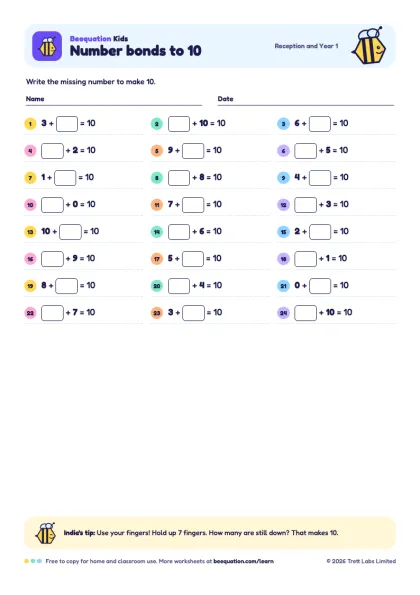 Number bonds to 10Reception, Year 1 · Pairs that make 10Download PDF
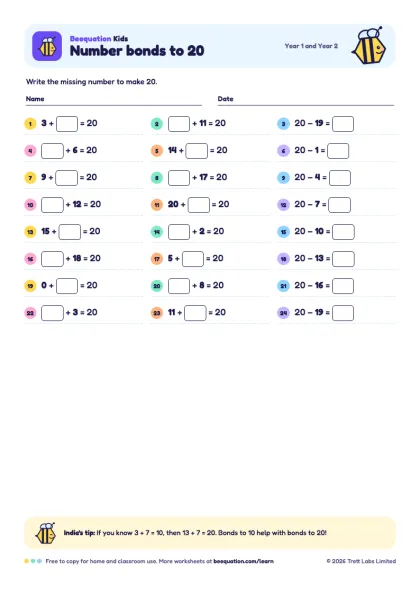 Number bonds to 20Year 1, Year 2 · Pairs that make 20Download PDF
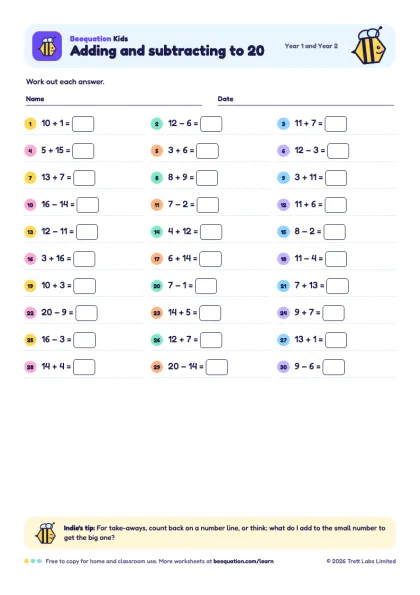 Adding and subtracting to 20Year 1, Year 2 · Mixed sums within 20Download PDF
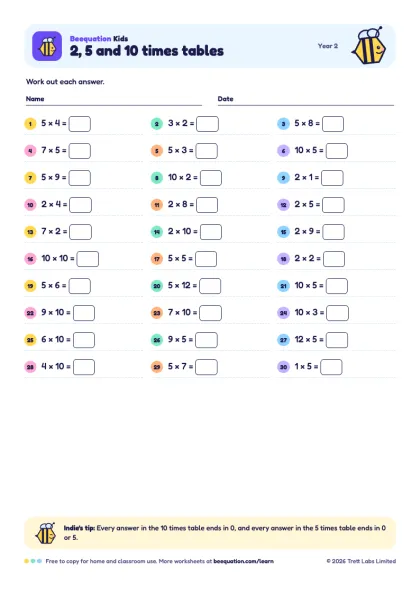 2, 5 and 10 times tablesYear 2 · Mixed questionsDownload PDF
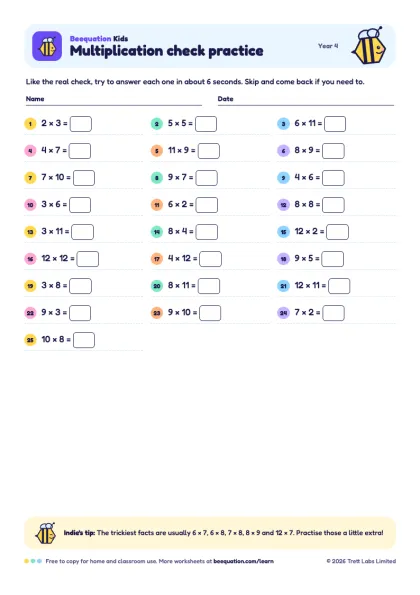 Multiplication check practiceYear 4 · 25 questions up to 12 × 12Download PDF
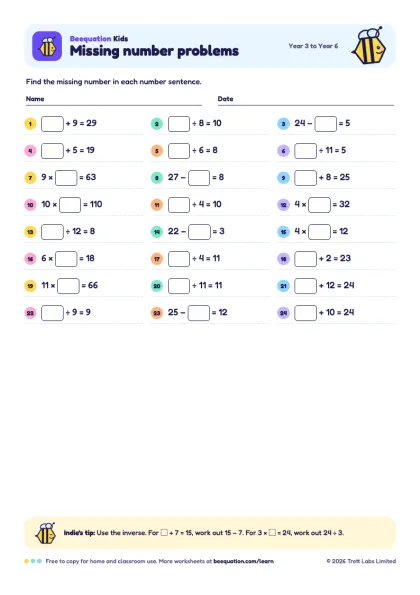 Missing number problemsYear 3, Year 4, Year 5, Year 6 · Find the number in the boxDownload PDF
Quick answers
Working out calculations in your head, using facts you know by heart and strategies such as partitioning or counting up. Short jottings to keep track still count as mental maths.
Fingers are a sensible tool while facts are new, especially in Reception and Year 1. As number bonds become familiar most children stop needing them. If your child still counts most sums in ones by Year 3, practise number bonds little and often.
By the end of Year 4 the curriculum expects all of them up to 12 × 12. That is when the Multiplication Tables Check happens: 25 questions on screen, 6 seconds each, with no pass mark.
There is no separate mental maths test. The Key Stage 2 arithmetic paper in Year 6 is written, but many of its questions are quickest with a mental method, and good estimation helps across all the papers.
Practise with Indie
Beequation Kids turns number facts into honeycomb puzzles, with Indie giving a hint when a child is stuck. No ads and no data collected.