Learn › Topics › Counting and place value
Topic guide
Counting and place value
Counting is saying numbers in order and matching one number to each thing you count. Place value is the idea that a digit is worth a different amount depending on where it sits in a number. In 333, each 3 means something different: 3 hundreds, 3 tens and 3 ones. Almost everything else in primary maths is built on these two ideas.
What children learn, year by year
This follows the EYFS framework for Reception and the National Curriculum in England from Year 1. US grades are roughly one year behind the UK year number.
| Year | What they learn |
|---|---|
| Reception | Count objects reliably and say numbers beyond 20 in order. Know numbers to 10 really well. Spot small amounts (up to 5) without counting, which is called subitising. Say which group has more, fewer or the same. |
| Year 1 | Count to and across 100, forwards and backwards, from any number. Count in 2s, 5s and 10s. Read and write numbers to 100 in digits, and 1 to 20 in words. Find one more and one less. |
| Year 2 | Count in 2s, 3s and 5s from 0, and in 10s from any number. Know the tens and ones in a two-digit number (47 is 4 tens and 7 ones). Compare and order numbers to 100 using <, > and =. |
| Year 3 | Hundreds, tens and ones in three-digit numbers. Find 10 or 100 more or less. Count in 4s, 8s, 50s and 100s. Compare and order numbers to 1,000. Read Roman numerals from I to XII on a clock. |
| Year 4 | Four-digit numbers. Find 1,000 more or less. Count in 6s, 7s, 9s, 25s and 1,000s. Count backwards through zero into negative numbers. Round to the nearest 10, 100 or 1,000. Roman numerals to 100 (C). |
| Year 5 | Read, write, compare and order numbers to at least 1,000,000. Count in steps of 10, 100, 1,000, 10,000 and 100,000. Negative numbers in real life, such as temperatures. Round to the nearest 10, 100, 1,000, 10,000 or 100,000. Roman numerals to 1,000 (M), including years. |
| Year 6 | Numbers up to 10,000,000 (ten million). Round any whole number to a sensible degree of accuracy. Use negative numbers and work out the gap across zero, such as from −4 to 3. |
The big ideas
1. Counting is more than saying the numbers
A child can recite "one, two, three…" long before they can count. Real counting means touching or pointing to each thing once, knowing that the last number said is how many there are, and knowing that the answer stays the same whichever order you count in. Count stairs, buttons and pasta shapes together, and ask "so how many are there?" at the end.
2. Where a digit sits tells you what it is worth
Our number system uses only ten digits, 0 to 9. Each column is worth ten times the column to its right: ten ones make one ten, ten tens make one hundred, ten hundreds make one thousand. Splitting a number into its parts, like 3,482 = 3,000 + 400 + 80 + 2, is called partitioning. Children will also partition in other ways, such as 3,482 = 3,000 + 300 + 182, which helps later with subtraction.
Zero matters too. In 405, the 0 is a placeholder: it shows there are no tens and keeps the 4 in the hundreds column. Without it, 405 would become 45.
3. Big numbers are read in groups of three
From Year 5, children work with numbers up to a million, and in Year 6 up to ten million. The trick is to split the digits into groups of three from the right. 4,072,519 is read as "four million, seventy-two thousand, five hundred and nineteen". Schools may write big numbers with commas or with small spaces (4 072 519). Both are fine.
Make place value something your child can hold. Bundle lolly sticks or straws into tens with an elastic band, and bundle ten tens into a hundred. Swapping ten loose sticks for one bundle is exactly what children do later in column addition, which schools call exchanging.
4. Comparing and rounding start from the left
To compare two numbers, line them up and look at the biggest column first. 5,309 and 5,290 both have 5 thousands, but 5,309 has 3 hundreds and 5,290 has only 2, so 5,309 > 5,290. Children learn the signs < (less than) and > (more than) in Year 2. The wide, open side always faces the bigger number.
Rounding means finding the nearest "tidy" number. Look at the digit to the right of the column you are rounding to: 5 or more rounds up, 4 or less rounds down. So 3,482 is 3,480 to the nearest 10, 3,500 to the nearest 100 and 3,000 to the nearest 1,000.
5. Numbers carry on below zero
Negative numbers are numbers less than zero. Children meet them in Year 4 by counting backwards past zero, then use them for temperatures in Year 5 and work out gaps across zero in Year 6. A thermometer or a lift with basement floors makes the idea concrete.
6. Roman numerals: a different way of writing numbers
The Romans used letters: I = 1, V = 5, X = 10, L = 50, C = 100, D = 500 and M = 1,000. You add the letters up (VIII = 8), unless a smaller letter comes before a bigger one, when you take it away (IV = 4, IX = 9, XL = 40, XC = 90). Children read I to XII on clock faces in Year 3, go up to C (100) in Year 4 and up to M (1,000) in Year 5, including years: MMXXVI is 2026. Roman numerals have no zero and no place value, which is one reason we use our own number system for calculating. Some clocks show 4 as IIII, which can puzzle children.
Common mistakes to look out for
- Teen number swaps: writing fourteen as 41, because you hear the "four" first.
- Writing numbers as they sound: "three hundred and four" written as 3004 instead of 304.
- Missing placeholders: writing 45 when they mean 405, or 5,07 for 5,007.
- Rounding changes too much or too little: rounding 3,482 to the nearest hundred and writing 3,582, or dropping the zeros and writing 35. Every digit to the right of the rounding column becomes 0.
- Negative number sizes: thinking −8 is bigger than −3 because 8 is bigger than 3. On a number line, −8 is further left, so it is smaller.
Five-minute counting and place value games for home
- Counting stairs. Count up the stairs, then down. Older children can count in 2s, 5s or 10s, or start from 37 and count back.
- Biggest number wins. Each player picks four digit cards (or rolls a dice four times) and makes the biggest number they can. With 7, 2, 9 and 4, the biggest is 9,742 and the smallest is 2,479.
- Guess my number. Think of a number up to 100 (or 1,000). Your child guesses, and you answer "higher" or "lower".
- Weather watch. In winter, look at the forecast together. How much warmer is 4 °C than −2 °C? (6 degrees.)
- Roman numeral spotting. Look for them on clocks, at the end of film credits and in the names of kings and queens, such as Henry VIII.
Indie's challengeIndie's hive has 4,705 bees. Then 300 more bees join. How many bees are there now, and what is that to the nearest thousand? Show the answer
4,705 + 300 = 5,005. The 7 hundreds and 3 hundreds make 10 hundreds, which is exchanged for 1 more thousand, so the hundreds column becomes 0. To the nearest thousand, 5,005 is 5,000, because the hundreds digit is 0, which rounds down.
Free counting and place value worksheets
Print these for practice at home or in class. Each one has an answer sheet on the second page.
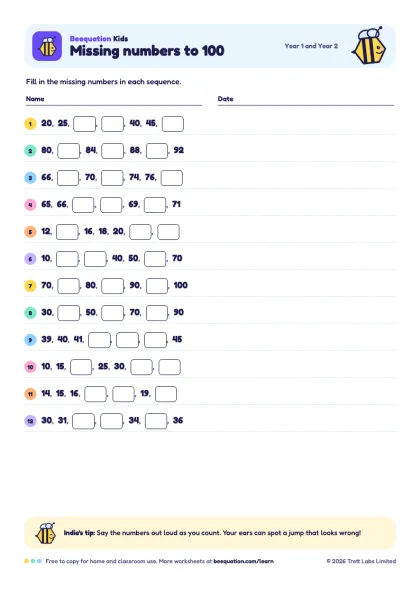 Missing numbers to 100Year 1, Year 2 · Count in 1s, 2s, 5s and 10sDownload PDF
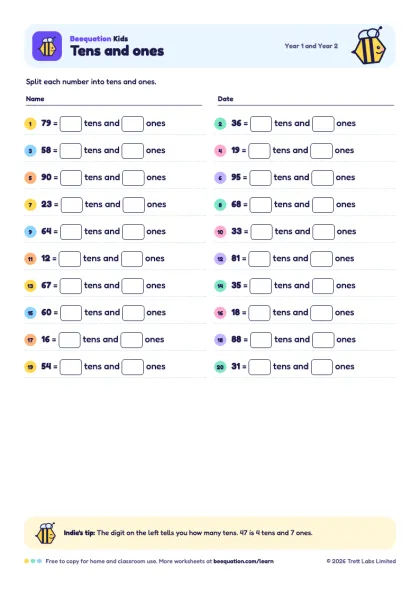 Tens and onesYear 1, Year 2 · Partition two-digit numbersDownload PDF
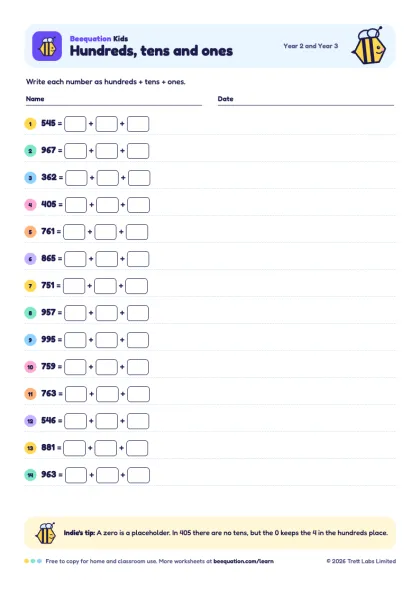 Hundreds, tens and onesYear 2, Year 3 · Place value to 1,000Download PDF
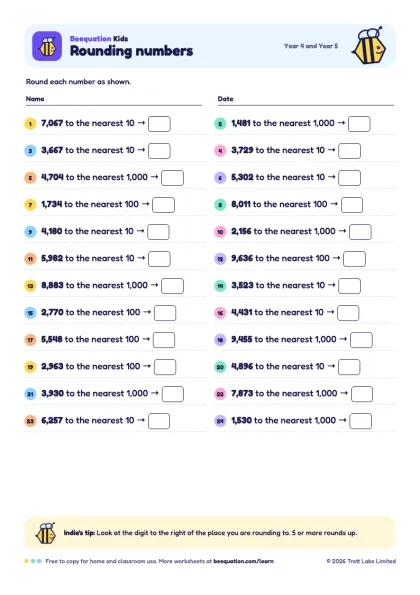 Rounding numbersYear 4, Year 5 · Round to the nearest 10, 100 and 1,000Download PDF
Quick answers
The value a digit has because of its position in a number. In 352, the 5 is in the tens column, so it is worth 50, not 5.
Digits are the ten symbols 0 to 9. Numbers are made from digits, in the same way that words are made from letters. 352 is one number made of three digits.
A number ending in 5, like 65, is exactly halfway between 60 and 70. The rule children learn at school is to round halfway numbers up, so 65 rounds to 70.
In Year 4 (age 8 to 9) they count backwards through zero. In Years 5 and 6 they use negative numbers for temperatures and find the difference between a negative and a positive number.
Practise with Indie
Beequation Kids turns number facts into honeycomb puzzles, with Indie giving a hint when a child is stuck. No ads and no data collected.