Topic guide
Fractions
A fraction is part of a whole that has been split into equal parts. The bottom number (the denominator) says how many equal parts the whole is split into. The top number (the numerator) says how many of those parts we have.
What children learn, year by year
This follows the National Curriculum in England. US grades are roughly one year behind the UK year number.
| Year | What they learn |
|---|---|
| Year 1 | Find a half and a quarter of a shape, an object or a small group of things. |
| Year 2 | Find ⅓, ¼, ²⁄₄ and ¾ of shapes, lengths and amounts (½ of 6 = 3). See that ²⁄₄ is the same as ½. |
| Year 3 | Count in tenths. Unit fractions (one part, like ⅕) and non-unit fractions (like ⅗). Simple equivalent fractions. Add and subtract fractions with the same denominator, such as ⁵⁄₇ + ¹⁄₇. |
| Year 4 | Families of equivalent fractions. Count in hundredths. Fractions of amounts, like ¾ of 20. Link tenths, hundredths, ¼, ½ and ¾ to decimals. |
| Year 5 | Mixed numbers (2½) and improper fractions (⁵⁄₂). Compare and order fractions. Add and subtract when one denominator is a multiple of the other. Multiply a fraction by a whole number. Percentages. |
| Year 6 | Simplify fractions. Add and subtract any fractions, including mixed numbers. Multiply two fractions (½ × ¼ = ⅛) and divide a fraction by a whole number (⅓ ÷ 2 = ⅙). Move between fractions, decimals and percentages. |
The big ideas
1. The parts must be equal
Children often call any piece "a half". Fold paper, cut sandwiches and share sweets, and keep asking "are the parts the same size?". A shape cut into two different-sized pieces is not split into halves.
2. A fraction can be part of a shape or part of a group
Half a pizza and half of 8 sweets are the same idea. To find a fraction of an amount, share the amount into the number of equal groups the denominator gives, then take as many groups as the numerator says. For ¾ of 12: split 12 into 4 groups of 3, then take 3 groups, which is 9.
3. Bigger denominator, smaller pieces
Many children think ⅛ is bigger than ¼ because 8 is bigger than 4. Show it: a cake shared between 8 people gives everyone a smaller slice than a cake shared between 4.
4. Different fractions can be worth the same
Multiplying (or dividing) the top and bottom by the same number gives an equivalent fraction: ½ = ²⁄₄ = ³⁄₆. Dividing both by the same number until you can't any more is called simplifying: ⁶⁄₈ = ¾.
When you add fractions, the denominator never gets added. ¼ + ¼ is two quarters, ²⁄₄, not ²⁄₈. Say it in words, "one quarter plus one quarter is two quarters", and the mistake disappears.
5. Adding fractions needs the same-sized pieces
You can only add fractions directly when they have the same denominator. To work out ½ + ⅓, change both into sixths first: ³⁄₆ + ²⁄₆ = ⁵⁄₆.
Common mistakes to look out for
- Unequal parts: calling the bigger "half" of something a half.
- Bigger number, bigger fraction: thinking ⅛ > ¼.
- Adding the bottoms: writing ⅓ + ⅓ = ²⁄₆.
- Forgetting the whole: ½ of a big pizza is more than ½ of a small one. A fraction is always a fraction of something.
Five-minute fraction games for home
- Fair shares at snack time. "Can you share these 12 grapes fairly between the 3 of us? What fraction does each person get?"
- Fold and name. Fold a sheet of paper in half, then half again. How many parts now? What is each part called? Keep going to eighths.
- Fraction of the journey. "We're halfway to Grandma's. What fraction is left?"
- Pizza maths. Cut a pizza (real or paper) into 8. Eat 3 slices: what fraction has gone? What fraction is left?
- Which is bigger? Hold up two fractions written on paper and decide together, drawing them if you need to.
Indie's challengeIndie had 20 honey drops and ate ¾ of them. How many are left? Show the answer
¾ of 20 is 15 (20 ÷ 4 = 5, and 5 × 3 = 15). So Indie ate 15 and 5 are left, which is the last ¼.
Free fractions worksheets
Print these for practice at home or in class. Each one has an answer sheet on the second page.
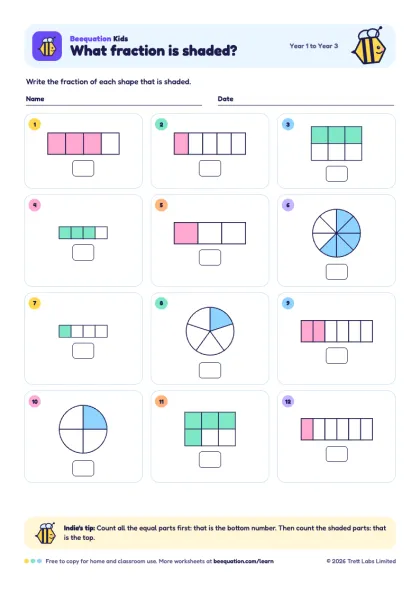 What fraction is shaded?Year 1, Year 2, Year 3 · Halves, thirds, quarters and moreDownload PDF
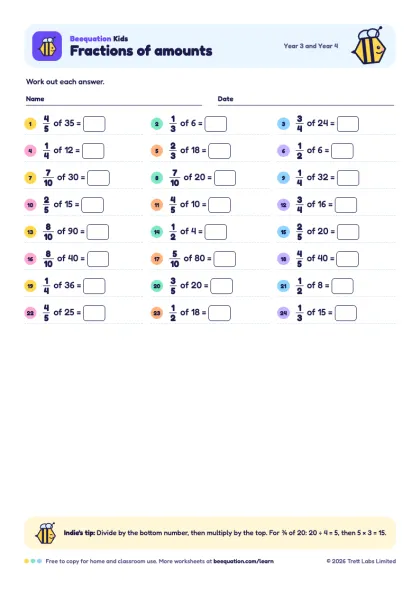 Fractions of amountsYear 3, Year 4 · Like ½ of 12 and ¾ of 20Download PDF
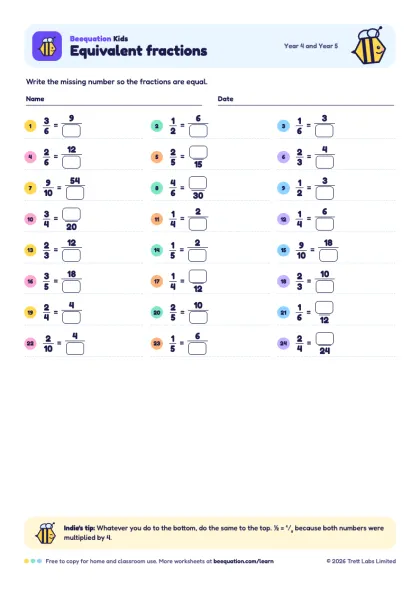 Equivalent fractionsYear 4, Year 5 · Find the missing numberDownload PDF
Quick answers
A fraction with 1 on top, such as ½, ⅓ or ⅒. It means one equal part.
A fraction whose top number is bigger than its bottom number, such as ⁷⁄₄. It is more than one whole, and can be written as a mixed number: 1¾.
Draw two bars the same length. Split one into halves and one into quarters, and shade ½ and ²⁄₄. They cover the same amount, so they are equal.
In Year 6 (age 10 to 11), although many start spotting equivalent fractions in Years 3 to 5.
Practise with Indie
Beequation Kids turns number facts into honeycomb puzzles, with Indie giving a hint when a child is stuck. No ads and no data collected.