Learn › Topics › Addition and subtraction
Topic guide
Addition and subtraction
Addition means putting amounts together to find the total. Subtraction means taking one amount away from another, or finding the difference between two amounts. They are two sides of the same idea: if 7 + 5 = 12, then 12 − 5 = 7. Children learn them side by side, starting with objects and pictures, then mental methods, and finally the written column method.
What children learn, year by year
This follows the EYFS framework for Reception and the National Curriculum in England from Year 1. US grades are roughly one year behind the UK year number.
| Year | What they learn |
|---|---|
| Reception | Know how numbers to 10 are made up (5 is 4 and 1, or 3 and 2). Recall number bonds to 5 and some to 10, including doubles. |
| Year 1 | Read and write sums using +, − and =. Number bonds and subtraction facts within 20. Add and subtract one-digit and two-digit numbers to 20, including zero. Missing number problems such as 7 = ? − 9. |
| Year 2 | Recall facts to 20 quickly and use them for facts to 100 (3 + 7 = 10, so 30 + 70 = 100). Add and subtract two-digit numbers, and add three one-digit numbers. Know that addition can be done in any order but subtraction cannot. Use the inverse to check. |
| Year 3 | Mentally add and subtract ones, tens or hundreds to a three-digit number. The column method for numbers with up to three digits. Estimate first, then check with the inverse. |
| Year 4 | The column method for numbers with up to four digits. Two-step word problems, choosing which operation to use. |
| Year 5 | Add and subtract numbers with more than four digits, in columns and mentally. Use rounding to check answers. Multi-step problems. |
| Year 6 | Mental calculations with large numbers and mixed operations. The order of operations. Estimating to check. Addition and subtraction questions appear on the Key Stage 2 SATs arithmetic paper in May. |
The big ideas
1. Number bonds are the foundation
Number bonds are pairs of numbers that make a total, such as 6 + 4 = 10 or 13 + 7 = 20. Children who know their bonds to 10 and 20 by heart can use them everywhere: if 6 + 4 = 10, then 60 + 40 = 100 and 16 + 4 = 20. Our guide to number bonds to 20 has ideas for practising them.
2. Addition and subtraction are a family
Subtraction is the inverse (opposite) of addition. From one fact you get a whole fact family: 7 + 5 = 12, 5 + 7 = 12, 12 − 5 = 7 and 12 − 7 = 5. This is also how children check their work. If 62 − 38 = 24, then 24 + 38 should make 62, and it does.
Addition can be done in any order (3 + 9 is the same as 9 + 3, so start with the bigger number and count on). Subtraction cannot: 9 − 3 is not the same as 3 − 9.
3. Mental methods come before written ones
Children learn several ways to work things out in their heads. The best method depends on the numbers:
- Partitioning: split numbers into tens and ones. 34 + 25 = 30 + 20 + 4 + 5 = 59.
- Bridging through 10: make a ten first. 8 + 5 = 8 + 2 + 3 = 13.
- Near doubles: 6 + 7 is double 6 plus 1, which is 13.
- Rounding and adjusting: to add 9, add 10 and take 1 away. 46 + 9 = 56 − 1 = 55.
There are more of these in our guide to mental maths strategies.
4. A number line shows the jumps
An empty number line (one with only the numbers you need marked on it) helps children see what they are doing. For subtraction there are two ways to use it: count back from the bigger number (take away), or count up from the smaller number to the bigger one (find the difference). Counting up is often quicker when the numbers are close together, like 62 − 38 or 1,003 − 996.
5. The column method lines up place value
From Year 3, children use the column method. The digits must be lined up: ones under ones, tens under tens, hundreds under hundreds. You always start with the ones column, on the right.
For 357 + 268: 7 + 8 = 15, so write 5 in the ones and carry the ten into the tens column. Then 5 + 6 + 1 = 12 tens, so write 2 and carry the hundred. Then 3 + 2 + 1 = 6 hundreds. The answer is 625.
Subtraction sometimes needs exchanging (you may remember it as "borrowing"). In the ones column of 532 − 217 below, 2 − 7 cannot be done, so one of the 3 tens is exchanged for 10 ones. Now there are 2 tens and 12 ones, and 12 − 7 = 5.
Before any written sum, ask your child roughly what the answer will be. For 357 + 268, rounding to 360 + 270 gives about 630, so an answer of 625 looks right and an answer of 515 is clearly too small. Schools write the carried and exchanged digits in slightly different places, so ask your child to show you how their class does it rather than teaching the way you learned.
Common mistakes to look out for
- Taking the smaller digit from the bigger one: working out 532 − 217 as 325, because 7 − 2 seems easier than 2 − 7. Each column is always top number take away bottom number.
- Forgetting the carried digit: getting 515 for 357 + 268 because the tens and hundreds that were carried over were never added.
- Lining up from the left: writing 245 + 32 with the 3 under the 2, giving 565 instead of 277.
- Exchanging across a zero: 400 − 128 needs a hundred exchanged into tens and then a ten into ones (3 hundreds, 9 tens and 10 ones). The answer is 272.
- Counting the starting number: for 7 + 2, saying "7, 8" on their fingers and answering 8. Start at 7 and count the jumps: "8, 9".
Five-minute adding games for home
- Make 10. Lay out playing cards from ace (1) to 9 face up. Take turns to find two cards that add up to 10.
- Number bond ping-pong. You say 7, your child says 3 (to make 10). Older children can play to 20 or to 100 (you say 35, they say 65).
- Dice race to 100. Roll two dice, add them and keep a running total. First to 100 wins.
- Shop change. Play shops with real coins. "It costs 65p and I give you £1. How much change?" (35p.)
- Number plate sums. On a car journey, add the digits on number plates. Who can spot a plate that adds up to 10?
Indie's challengeIndie collected 245 drops of nectar in the morning and 187 in the afternoon. How many did she collect altogether, and how many more did she collect in the morning? Show the answer
Altogether: 245 + 187 = 432 (5 + 7 = 12, write 2 and carry 1 ten; 4 + 8 + 1 = 13 tens, write 3 and carry 1 hundred; 2 + 1 + 1 = 4 hundreds). How many more: 245 − 187 = 58. Count up from 187: 13 more makes 200, then 45 more makes 245, and 13 + 45 = 58. Check: 187 + 58 = 245.
Free addition and subtraction worksheets
Print these for practice at home or in class. Each one has an answer sheet on the second page.
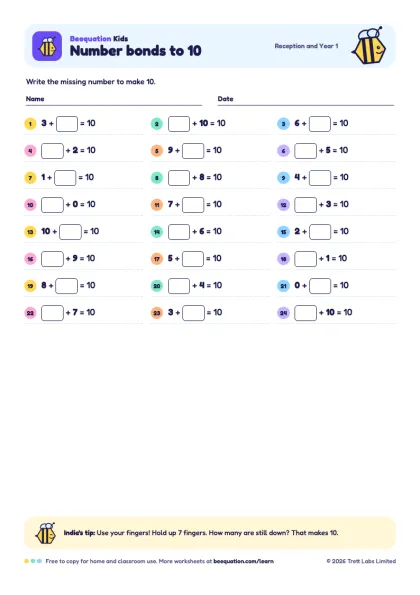 Number bonds to 10Reception, Year 1 · Pairs that make 10Download PDF
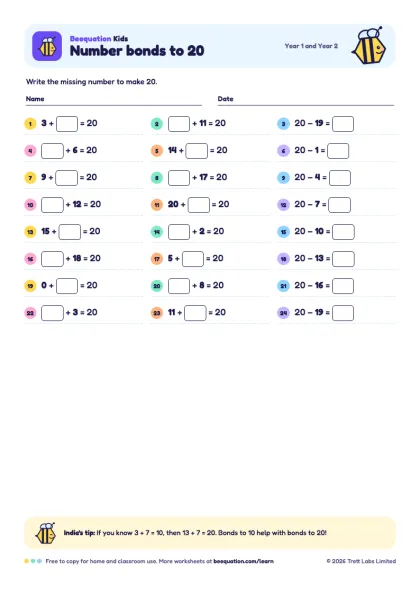 Number bonds to 20Year 1, Year 2 · Pairs that make 20Download PDF
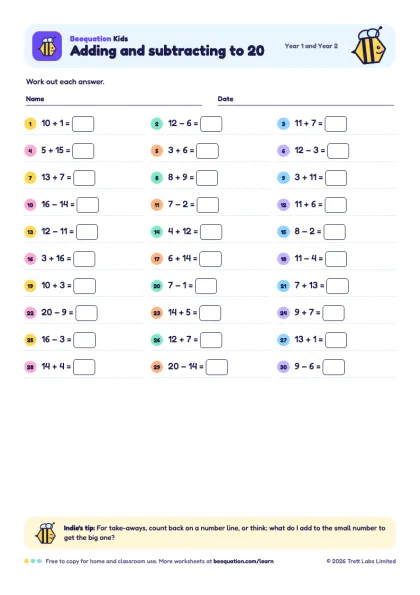 Adding and subtracting to 20Year 1, Year 2 · Mixed sums within 20Download PDF
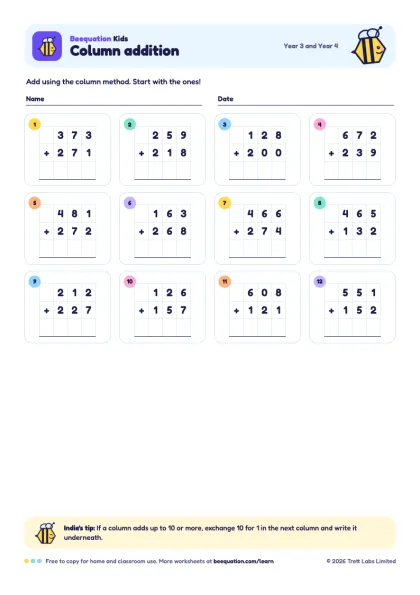 Column additionYear 3, Year 4 · Three-digit numbers, with exchangingDownload PDF
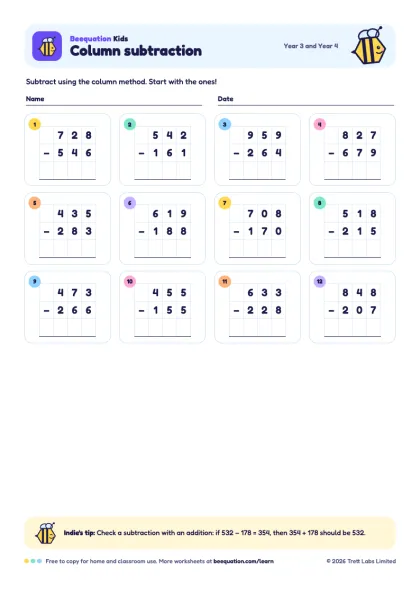 Column subtractionYear 3, Year 4 · Three-digit numbers, with exchangingDownload PDF
Quick answers
Swapping one ten for ten ones (or one hundred for ten tens) so that a column has enough to subtract from. It used to be called borrowing. The number stays the same: 2 tens and 12 ones is still 32.
In Year 3 (age 7 to 8), for numbers with up to three digits. In Year 4 they use it for four-digit numbers, and in Year 5 for bigger numbers still.
How much bigger one number is than another. The difference between 9 and 6 is 3. You can find it by subtracting (9 − 6) or by counting up from 6 to 9.
Fingers are fine while children are learning, and they help many children see how numbers are built. Over time, aim for number bonds and doubles to be remembered rather than counted.
Practise with Indie
Beequation Kids turns number facts into honeycomb puzzles, with Indie giving a hint when a child is stuck. No ads and no data collected.