Learn › Year groups › Year 1
Year group guide
Year 1 maths: what your child learns (age 5 to 6)
Year 1 is for children aged 5 to 6, roughly the same as Kindergarten in the US. It's the first year of Key Stage 1 and the first year of the National Curriculum in England. Lessons are still very practical, with cubes, counters, ten frames and number lines, but there is a bit more sitting at tables and writing number sentences than in Reception.
What Year 1 children are working on
Year 1 takes the numbers to 10 from Reception and stretches them to 100. The most important skill of the year is knowing number bonds: the pairs that make 10 (like 6 + 4) and then the facts within 20 (like 16 + 4 = 20 and 13 − 5 = 8). These facts are used in almost every calculation children meet later, so they're worth the time.
Children also meet halves and quarters, coins and notes, o'clock and half past, and the names of common flat and solid shapes.
The Year 1 maths curriculum
This follows the National Curriculum in England. Each heading links to a full guide to that topic.
Number and place value
- Count to and across 100, forwards and backwards, starting from 0, 1 or any number (for example 87, 88, 89, 90, 91).
- Count in 2s, 5s and 10s.
- Read and write numbers to 100 in numerals, and from 1 to 20 in words.
- Say one more and one less than any number.
- Show numbers with objects, pictures and number lines, and use the words equal to, more than, less than (fewer), most and least.
Addition and subtraction
- Read, write and understand number sentences using +, − and =.
- Know number bonds and the matching subtraction facts within 20: 7 + 3 = 10, so 10 − 3 = 7, and 17 + 3 = 20.
- Add and subtract one-digit and two-digit numbers to 20, including zero: 12 + 5 = 17, 15 − 9 = 6, 8 + 0 = 8.
- Solve one-step problems with objects and pictures, and missing number problems such as 7 = □ − 9 (the missing number is 16).
Multiplication and division
- Solve one-step problems by making equal groups, sharing and using arrays, with objects and pictures and with help from the teacher. For example, 4 pairs of socks is 2, 4, 6, 8 socks.
- There are no times tables to learn by heart yet. Counting in 2s, 5s and 10s is the start.
Fractions
- Find and name a half: one of two equal parts of a shape, an object or an amount. Half of 8 is 4.
- Find and name a quarter: one of four equal parts. A quarter of 8 is 2.
Measurement: length, mass, capacity
- Compare lengths and heights (longer, shorter, taller), mass or weight (heavier, lighter), and capacity and volume (full, empty, half full).
- Begin to measure and record these, often with cubes or hand spans at first, then with rulers and scales.
Measurement: money
- Recognise the coins (1p, 2p, 5p, 10p, 20p, 50p, £1 and £2) and notes (£5, £10, £20 and £50), and know what each one is worth.
Measurement: time
- Tell the time to the hour and half past the hour, and draw the hands on a clock face.
- Put events in order using words like before, after, next, first, today, yesterday, tomorrow, morning, afternoon and evening.
- Know the days of the week, and use words for dates such as weeks, months and years.
- Compare times (quicker, slower, earlier, later) and begin to measure time in hours, minutes and seconds.
Geometry: properties of shapes
- Recognise and name 2D (flat) shapes: rectangles (including squares), circles and triangles.
- Recognise and name 3D (solid) shapes: cuboids (including cubes), pyramids and spheres.
Geometry: position and direction
- Describe position, direction and movement, including whole, half, quarter and three-quarter turns.
By the end of Year 1, most children can…
- count to 100 and back, starting from any number
- count in 2s, 5s and 10s
- read and write numbers to 100, and write the numbers one to twenty in words
- say one more and one less than any number to 100
- recall the number bonds to 10 and use them for facts within 20
- add and subtract numbers within 20, such as 14 + 5 = 19 and 17 − 8 = 9
- find a half and a quarter of a shape or a small group of objects
- name all the coins and notes
- tell the time to o'clock and half past
- name common 2D and 3D shapes, and make a quarter, half or whole turn
Key vocabulary
| Word | What it means |
|---|---|
| Number bond | A pair of numbers that make another number: 6 and 4 are a number bond to 10. |
| Add, plus, altogether | Put amounts together. The sign is +. |
| Subtract, take away, minus | Take an amount away, or find the difference. The sign is −. |
| Equals | Is the same as. The sign is =, and the answer can be on either side: 10 = 6 + 4. |
| Number sentence | A calculation written with numbers and signs, like 5 + 3 = 8. |
| Fewer, less than, more than | Words for comparing two numbers or groups. |
| Half, quarter | One of two, or one of four, equal parts. |
| Array | Objects arranged in equal rows, such as 3 rows of 4 eggs. |
| O'clock, half past | On the hour (the long hand points to 12) and half way to the next hour (it points to 6). |
| Cube, cuboid, pyramid, sphere | Solid shapes: a dice, a cereal box, a pointed tent shape and a ball. |
Tests in Year 1
There are no national maths tests in Year 1. Your child's teacher will keep track of how they're getting on through everyday work and talk to you about it at parents' evenings.
How to help at home
- Practise bonds to 10 with fingers. Hold up 10 fingers, fold some down and ask how many are still up. Then move on to bonds to 20. Our guide to number bonds to 20 has more ideas.
- Count in 2s, 5s and 10s. Socks and shoes come in 2s, fingers on a hand in 5s, and 10p coins in 10s.
- Play shops. Use real coins so your child learns what they look like and what each is worth.
- Notice o'clock and half past. "It's 4 o'clock: snack time!" works better than a worksheet.
- Halve things fairly. Cut a sandwich in half, or share 10 grapes into two equal groups.
- Hunt for shapes. A tin of beans is a cylinder, a cereal box is a cuboid and a football is a sphere.
Hide some of a small group and ask how many are hidden. Put 10 pasta pieces on the table, cover some with a cup and show the rest: "I can see 6. How many are under the cup?" It turns number bonds into a game and shows your child that 6 + 4 = 10 and 10 − 6 = 4 are the same fact.
Indie's challengeIndie had 15 honey drops. She gave 6 of them to the queen bee. How many honey drops does Indie have left? Show the answer
Indie has 9 honey drops left. 15 − 6: take away 5 to get to 10, then take away 1 more to get 9. Check by adding back: 9 + 6 = 15.
Free Year 1 maths worksheets
Print these for practice at home or in class. Each one has an answer sheet on the second page.
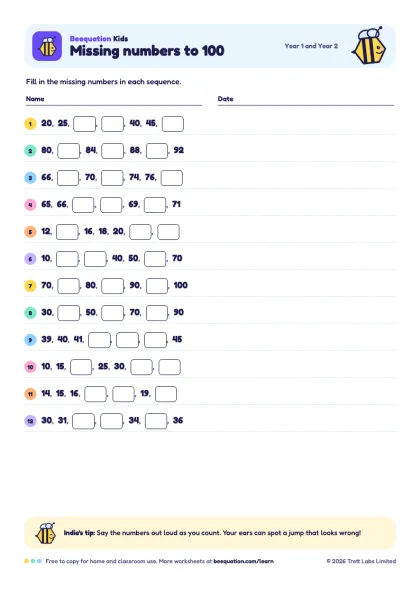 Missing numbers to 100Year 1, Year 2 · Count in 1s, 2s, 5s and 10sDownload PDF
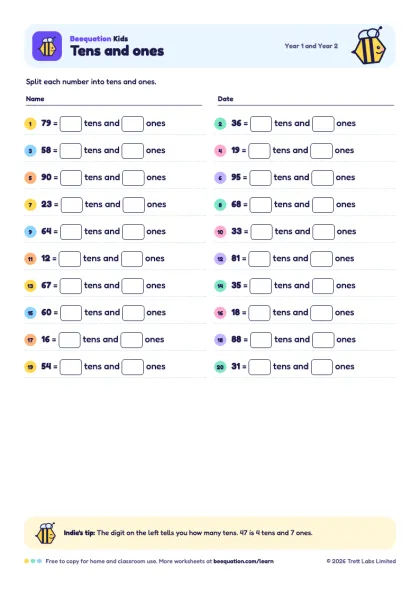 Tens and onesYear 1, Year 2 · Partition two-digit numbersDownload PDF
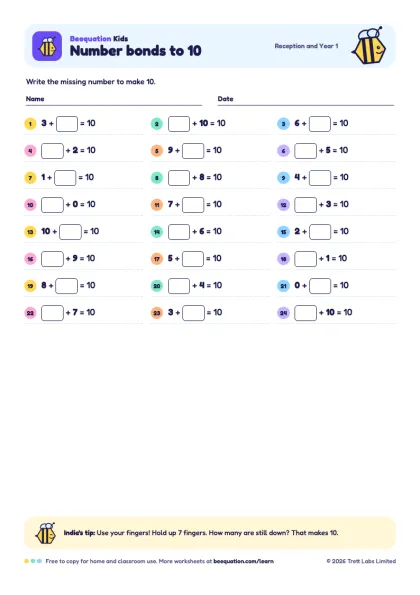 Number bonds to 10Reception, Year 1 · Pairs that make 10Download PDF
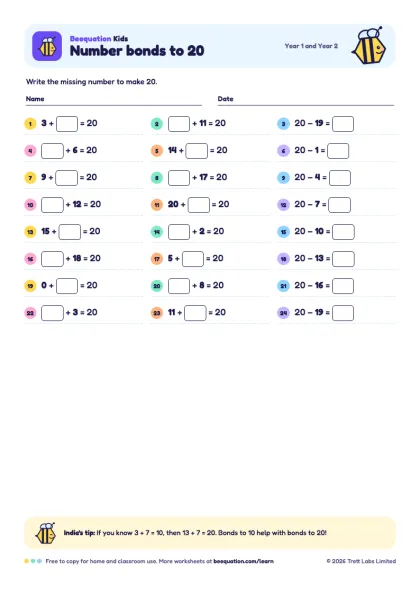 Number bonds to 20Year 1, Year 2 · Pairs that make 20Download PDF
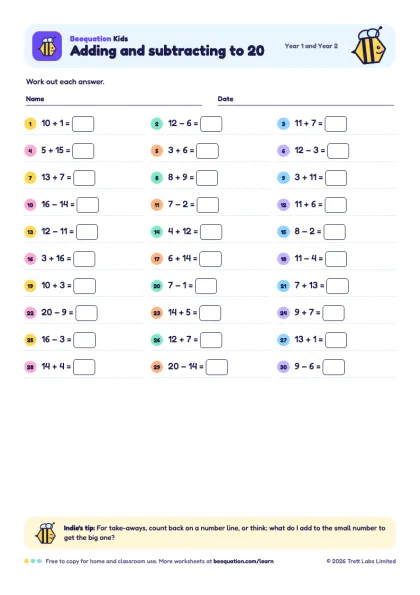 Adding and subtracting to 20Year 1, Year 2 · Mixed sums within 20Download PDF
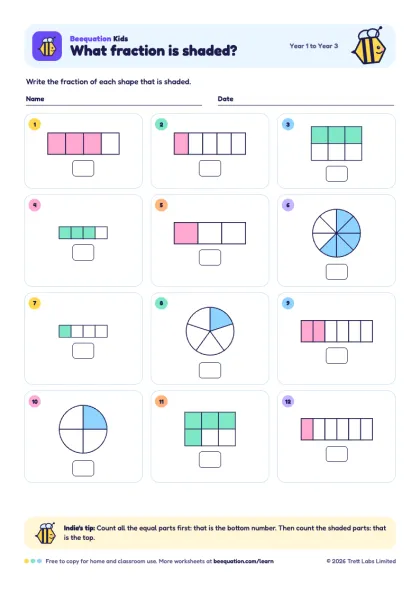 What fraction is shaded?Year 1, Year 2, Year 3 · Halves, thirds, quarters and moreDownload PDF
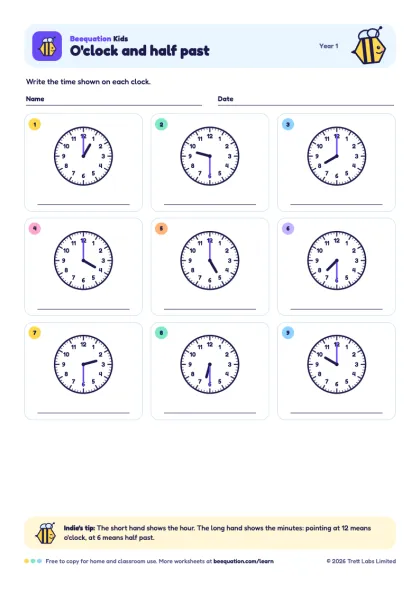 O'clock and half pastYear 1 · Read the clocksDownload PDF
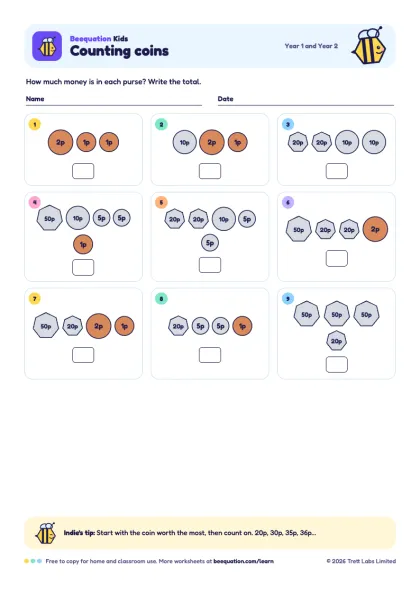 Counting coinsYear 1, Year 2 · Add up UK coinsDownload PDF
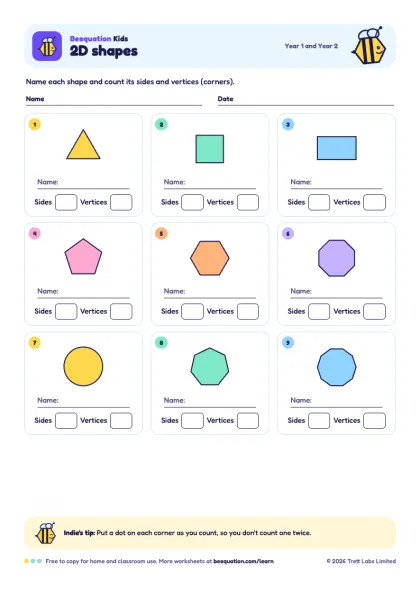 2D shapesYear 1, Year 2 · Names, sides and verticesDownload PDF
Quick answers
Pairs of numbers that add up to a given number. The number bonds to 10 are 0 + 10, 1 + 9, 2 + 8, 3 + 7, 4 + 6 and 5 + 5 (and the same pairs the other way round). Year 1 children learn these by heart, then use them for facts within 20.
No. Year 1 children count in 2s, 5s and 10s and solve sharing and grouping problems with objects. The 2, 5 and 10 times tables are learned in Year 2.
Children are 5 at the start of Year 1 and turn 6 during the year. It's roughly Kindergarten in the US.
Tell the time to o'clock and half past, draw the hands on a clock for those times, know the days of the week, and use words like before, after, today, tomorrow, weeks, months and years.
Practise with Indie
Beequation Kids turns number facts into honeycomb puzzles, with Indie giving a hint when a child is stuck. No ads and no data collected.