Learn › Year groups › Reception
Year group guide
Reception maths: what your child learns (age 4 to 5)
Reception is the first year of primary school in England, for children aged 4 to 5. It's roughly the same as Pre-K in the US. Reception is the last year of the Early Years Foundation Stage (EYFS), so it follows the EYFS framework, not the National Curriculum. The National Curriculum starts in Year 1.
Most Reception maths happens through play: counting toys, building towers, sharing snacks, singing number rhymes and spotting shapes outside. There are short whole-class sessions too, often with real objects, fingers, dice and ten frames.
What Reception children are working on
The big aim of Reception maths is number sense: really understanding what the numbers up to 10 mean, not only reciting them. A child who can count to 20 out loud may still not know that the last number they say tells you how many there are. Reception is where that link is made.
Children learn that every number up to 10 is made of smaller numbers (5 is 4 and 1, or 3 and 2), that one more than a number is the next number when you count, and that you can compare two groups to see which has more.
The Reception maths curriculum (EYFS)
At the end of Reception, teachers check each child against the Early Learning Goals. There are two for maths:
| Early Learning Goal | What it means |
|---|---|
| Number | Have a deep understanding of numbers to 10, including how each number is made up. Subitise (recognise how many without counting) up to 5. Know number bonds to 5 without counting, including the matching take-away facts, and some number bonds to 10, including doubles. |
| Numerical patterns | Count out loud beyond 20, seeing the pattern in the counting numbers. Compare amounts up to 10 and say which is more, less or the same. Explore patterns in numbers to 10, including odd and even numbers, doubles and how amounts can be shared equally. |
Here is what that looks like, topic by topic.
Counting and comparing
- Counting a group of objects by touching or moving each one once, and knowing the last number said is how many there are.
- Subitising: seeing 1, 2, 3, 4 or 5 things (like the dots on a dice) and knowing how many straight away.
- Counting out loud past 20 (twenty-one, twenty-two…) and noticing the pattern repeats.
- Comparing two groups up to 10: which has more, which has fewer, or are they the same?
- Recognising numerals 0 to 10 and matching them to amounts.
Number bonds, adding and taking away
- Knowing how each number to 10 is made: 6 is 5 and 1, 4 and 2, or 3 and 3.
- Number bonds to 5 by heart: 0 and 5, 1 and 4, 2 and 3. And the take-away facts that go with them: 5 take away 2 is 3.
- Some number bonds to 10, such as 5 and 5, and 8 and 2.
- Finding one more and one less than a number.
Doubling, sharing and odd and even
- Doubles: double 2 is 4, double 3 is 6, double 5 is 10.
- Sharing a group of things fairly so everyone has the same.
- Odd and even: an even number of things can all be put in pairs; an odd number always has one left over.
Shape, space, pattern and measures
These are part of the EYFS maths programme, although they aren't in the Early Learning Goals themselves. Children learn them through play:
- Naming and talking about shapes: circle, triangle, square, rectangle, and solid shapes like cubes and balls (spheres).
- Building, fitting shapes together and taking them apart.
- Copying, continuing and making patterns: red, blue, red, blue…
- Position words: on top, under, next to, behind, in front.
- Comparing length, weight and capacity: longer, shorter, heavier, lighter, full, empty. See the measurement guide.
By the end of Reception, most children can…
- count a group of up to 10 objects accurately, and say how many there are
- see how many are in a group of up to 5 without counting
- count out loud to 20 and beyond
- say which of two groups (up to 10) has more, fewer or the same
- say the pairs that make 5 without counting, and some pairs that make 10
- know some doubles, like double 4 is 8
- share a small number of things fairly, and spot whether a number is odd or even by putting things into pairs
- name common flat and solid shapes, and copy and continue a simple pattern
Key vocabulary
These are the words your child will hear in Reception. Using them at home helps.
| Word | What it means |
|---|---|
| Count | Say the numbers in order, one for each thing. |
| How many? | The number of things in a group. When you count, it's the last number you say. |
| More, fewer, the same | Comparing two groups. "Fewer" is used for things you can count. |
| One more, one less | The next number up or down when you count. |
| Altogether | All the things put together, the first idea of adding. |
| Take away | Remove some things and see how many are left. |
| Double | The same amount again: double 3 is 3 and 3, which is 6. |
| Share fairly | Give everyone the same amount. |
| Odd and even | Even numbers of things can be put in pairs. Odd numbers have one left over. |
| Pattern | Something that repeats in the same way, like red, blue, red, blue. |
Tests in Reception
The Reception Baseline Assessment happens in the first six weeks of Reception. It is a short set of practical activities your child does one-to-one with a teacher or teaching assistant, covering early maths and early language. There is nothing to prepare for and no pass or fail. It's used as a starting point to measure how much progress the whole school helps children make by the end of Year 6.
At the end of Reception, the teacher completes the EYFS Profile, saying for each Early Learning Goal whether your child is at the expected level or still working towards it ("emerging"). This is based on what the teacher has seen during the year, not on a test.
How to help at home
- Count real things. Stairs, buttons, grapes, cars that go past. After counting, ask "so how many are there?"
- Play dice games. Snakes and ladders and other board games are great for subitising: children soon recognise the dot patterns without counting.
- Hide and find. Put 5 toys under a tea towel, take some out and ask how many are still hidden. This builds number bonds to 5.
- Share snacks fairly. "Can you share these 8 raisins between you and me?" Then ask whether the number was odd or even.
- Sing number rhymes. "Five little ducks" and "Ten green bottles" practise counting back and one less.
- Go on a shape hunt. Find circles, triangles and rectangles around the house or on a walk.
After your child counts a group, ask "How many are there?" If they start counting again from 1, they haven't yet linked the last number they said to the size of the group. That's normal at this age. Count together, stress the last number ("one, two, three, four, four cars!") and ask again another day.
Indie's challengeIndie found 3 flowers in the garden and 2 flowers by the pond. How many flowers did she find altogether? Show the answer
Indie found 5 flowers. Start at 3 and count on 2 more: four, five. 3 and 2 make 5, which is one of the number bonds to 5.
Free Reception maths worksheets
Most Reception maths is best done with real objects, but these sheets are good for a quiet moment. Each one has an answer sheet on the second page.
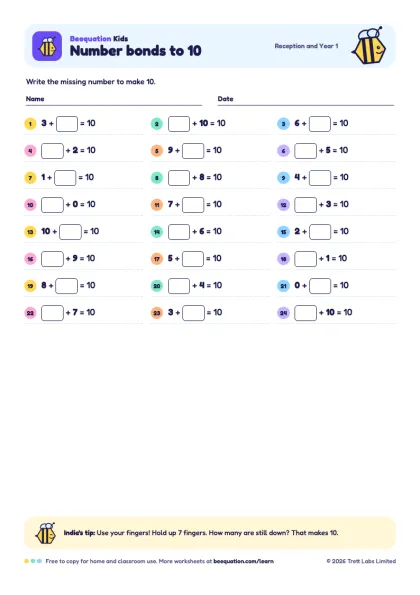 Number bonds to 10Reception, Year 1 · Pairs that make 10Download PDF
Quick answers
No. Reception follows the Early Years Foundation Stage (EYFS) framework, which is mostly learning through play. The National Curriculum starts in Year 1.
Recognising how many things there are in a small group without counting them, like knowing a dice shows 5 from the pattern of dots. Reception children learn to subitise up to 5.
The Early Learning Goal is to count out loud beyond 20 and to understand the numbers up to 10 really well, including how each one is made up.
The maths goals are about understanding numbers rather than writing them. Many children learn to write the numerals 0 to 10 during the year, but counting and number sense matter more.
Practise with Indie
Beequation Kids turns number facts into honeycomb puzzles, with Indie giving a hint when a child is stuck. No ads and no data collected.