Learn › Year groups › Year 3
Year group guide
Year 3 maths: what your child learns (age 7 to 8)
Year 3 is for children aged 7 to 8, roughly the same as Grade 2 in the US. It's the first year of Key Stage 2 (juniors), and for many children it means a new school or a new part of the building. Numbers grow to 1,000, the written column methods arrive, and fractions start to be treated as numbers in their own right.
What Year 3 children are working on
Year 3 builds on Year 2 place value with a third digit: hundreds. Knowing that 352 is 300 + 50 + 2 is what makes the column methods of addition and subtraction work, so expect plenty of practice with place value counters, base 10 blocks and number lines.
Children also learn three new times tables (3, 4 and 8), read clocks to the nearest minute, including Roman numerals and the 24-hour clock, and start measuring perimeter and spotting right angles.
The Year 3 maths curriculum
This follows the National Curriculum in England. Each heading links to a full guide to that topic.
Number and place value
- Count from 0 in multiples of 4, 8, 50 and 100.
- Find 10 or 100 more or less than a number: 100 more than 465 is 565.
- Know the value of each digit in a three-digit number (hundreds, tens and ones).
- Compare and order numbers up to 1,000.
- Read and write numbers to 1,000 in numerals and in words.
Addition and subtraction
- Add and subtract mentally: a three-digit number and ones (465 + 4 = 469), and tens (465 + 30 = 495), and hundreds (465 + 300 = 765).
- Add and subtract numbers with up to three digits using the column method.
- Estimate answers first, and use the inverse to check: if 347 + 285 = 632, then 632 − 285 should be 347.
- Solve problems, including missing number problems.
Multiplication and division
- Recall and use the 3, 4 and 8 times tables and the division facts that go with them.
- Multiply a two-digit number by a one-digit number, first mentally and then with written methods: 23 × 4 = 20 × 4 + 3 × 4 = 80 + 12 = 92.
- Solve problems, including scaling ("a tower 4 times as tall") and combinations: 3 hats and 4 scarves make 3 × 4 = 12 different outfits.
Fractions
- Count up and down in tenths (¹⁄₁₀, ²⁄₁₀, ³⁄₁₀…) and know that tenths come from dividing something into 10 equal parts.
- Find unit fractions (one part, like ⅓) and non-unit fractions (more than one part, like ⅔) of a group: ⅓ of 12 is 4, so ⅔ of 12 is 8.
- Understand fractions as numbers, for example placing ½ and ¾ on a number line.
- Show equivalent fractions with diagrams: ½ = ²⁄₄.
- Add and subtract fractions with the same denominator within one whole: ⁵⁄₇ + ¹⁄₇ = ⁶⁄₇.
- Compare and order unit fractions (⅕ is smaller than ⅓) and fractions with the same denominator.
Measurement: length, mass, capacity, perimeter
- Measure, compare, add and subtract lengths (m, cm and mm), mass (kg and g) and capacity (litres and ml).
- Measure the perimeter (the distance all the way round) of simple shapes: a rectangle 5 cm long and 3 cm wide has a perimeter of 5 + 3 + 5 + 3 = 16 cm.
Measurement: money
- Add and subtract amounts of money and give change, using both £ and p: change from £5 for something costing £3.45 is £1.55.
Measurement: time
- Tell the time on a clock with hands, including clocks with Roman numerals from I to XII, and use 12-hour and 24-hour clocks.
- Read the time to the nearest minute.
- Use a.m., p.m., morning, afternoon, noon and midnight.
- Know there are 60 seconds in a minute, and the number of days in each month, in a year (365) and in a leap year (366).
- Record and compare times in seconds, minutes and hours, and compare how long things take.
Geometry: properties of shapes
- Draw 2D shapes and make 3D shapes, and recognise 3D shapes turned different ways.
- Understand an angle as part of a shape or as an amount of turn.
- Find right angles, and know that two right angles make a half turn, three make three-quarters of a turn and four make a whole turn.
- Say whether an angle is bigger or smaller than a right angle.
- Find horizontal and vertical lines, and pairs of perpendicular and parallel lines.
There is no separate "position and direction" section in Year 3. It returns with coordinates in Year 4.
Statistics
- Read and make bar charts, pictograms and tables.
- Answer one-step and two-step questions such as "how many more?" and "how many fewer?", including on charts where each picture or square stands for more than one.
By the end of Year 3, most children can…
- read, write and order numbers to 1,000 and say what each digit is worth
- add and subtract three-digit numbers using the column method, such as 347 + 285 = 632
- recall the 2, 3, 4, 5, 8 and 10 times tables and the division facts that go with them
- multiply a two-digit number by a one-digit number, such as 23 × 4 = 92
- find fractions of amounts, such as ⅔ of 12 = 8, and add fractions like ²⁄₅ + ⅕ = ⅗
- measure lengths in m, cm and mm, and work out the perimeter of a rectangle
- work out change from £5 or £10
- tell the time to the nearest minute, including on a clock with Roman numerals
- spot right angles and say whether other angles are bigger or smaller
- read and draw a bar chart
Key vocabulary
| Word | What it means |
|---|---|
| Hundreds, tens, ones | The three parts of a three-digit number: 352 is 3 hundreds, 5 tens and 2 ones. |
| Column method | Writing numbers one above the other, lining up the ones, tens and hundreds, and working from the ones column. |
| Exchange | Swapping 10 ones for a ten (or 10 tens for a hundred). Many schools now say this instead of "carry" or "borrow". |
| Estimate | A sensible guess, often by rounding first: 347 + 285 is about 350 + 290 = 640. |
| Unit fraction | A fraction with 1 on top, such as ¼. |
| Numerator, denominator | The top and bottom numbers of a fraction. |
| Tenth | One of 10 equal parts: ¹⁄₁₀. |
| Perimeter | The distance all the way round the edge of a shape. |
| Right angle | A quarter turn, like the corner of a book. |
| Perpendicular, parallel | Lines that meet at a right angle, and lines that never meet, like railway tracks. |
Tests in Year 3
There are no national maths tests in Year 3. Your child's school may use its own short assessments during the year. It's worth knowing that the Multiplication Tables Check comes in June of Year 4, so the 3, 4 and 8 times tables learned this year are a big part of getting ready.
How to help at home
- Link the times tables. The 4 times table is double the 2s, and the 8s are double the 4s: 3 × 2 = 6, 3 × 4 = 12, 3 × 8 = 24. See our times tables practice ideas.
- Read real clocks. Ask the time on clocks with hands, and look out for Roman numerals on church clocks and watches.
- Use the 24-hour clock. Train and bus times, the oven and the car clock often use it. "The film starts at 14:30. What's that in the afternoon?"
- Measure things. Use a tape measure to find the perimeter of a table, a rug or a garden bed.
- Share in fractions. "There are 12 biscuits. If you have ¼ of them, how many is that?"
- Hunt for right angles. Door frames, windows and book corners all have them.
When your child exchanges in the column method, ask what the little number is worth. In 347 + 285, the ones make 12, so 2 is written down and 1 ten goes into the tens column. Saying "1 ten" rather than "carry the 1" keeps place value in their mind and makes mistakes easier to spot.
Indie's challengeIndie's hive makes 8 jars of honey every week. After 6 weeks, Indie gives 19 jars away to her friends. How many jars are left? Show the answer
There are 29 jars left. First, 6 × 8 = 48 jars in 6 weeks. Then 48 − 19 = 29 (take away 20 to get 28, then add 1 back). Check: 29 + 19 = 48.
Free Year 3 maths worksheets
Print these for practice at home or in class. Each one has an answer sheet on the second page.
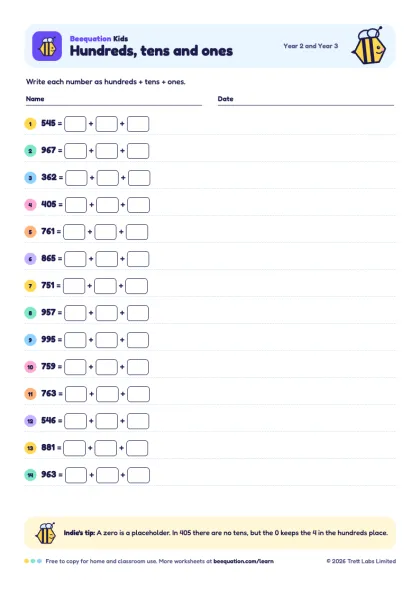 Hundreds, tens and onesYear 2, Year 3 · Place value to 1,000Download PDF
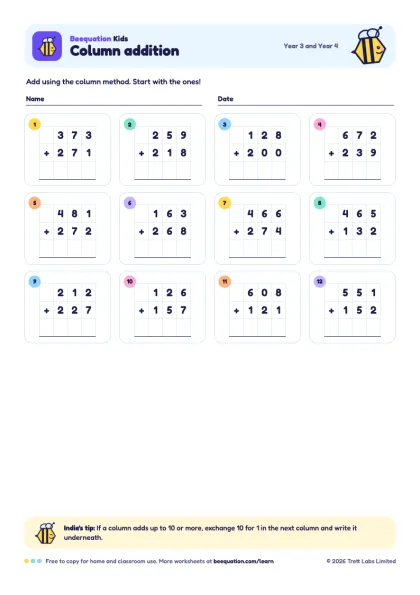 Column additionYear 3, Year 4 · Three-digit numbers, with exchangingDownload PDF
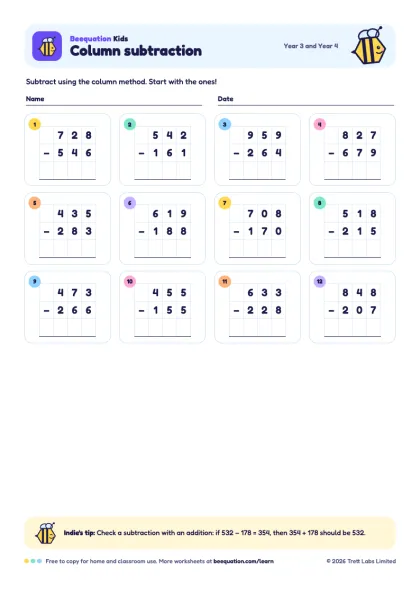 Column subtractionYear 3, Year 4 · Three-digit numbers, with exchangingDownload PDF
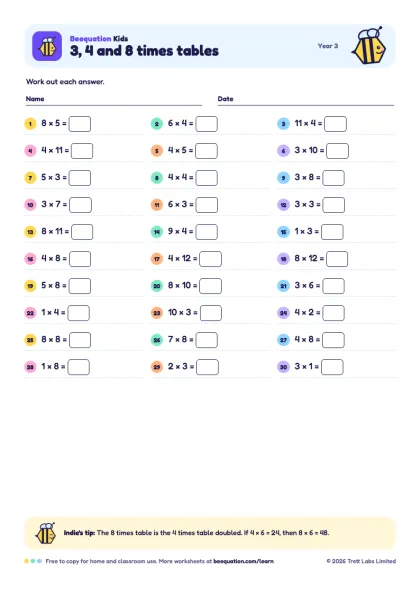 3, 4 and 8 times tablesYear 3 · Mixed questionsDownload PDF
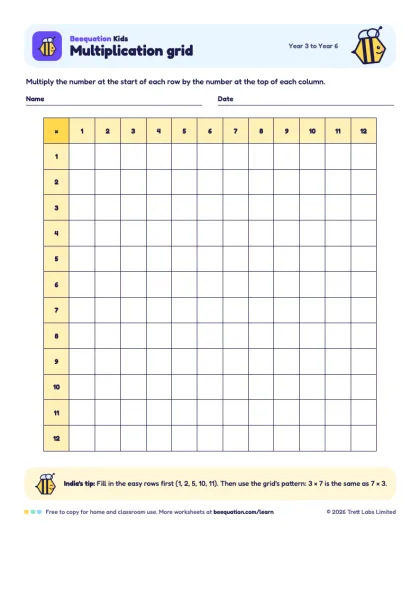 Multiplication gridYear 3, Year 4, Year 5, Year 6 · Fill in the 12 × 12 gridDownload PDF
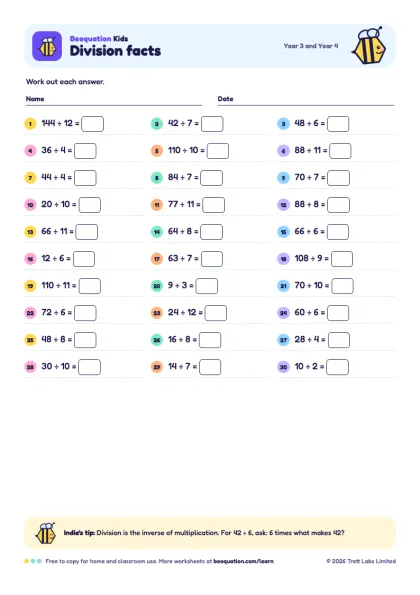 Division factsYear 3, Year 4 · Using times tables to divideDownload PDF
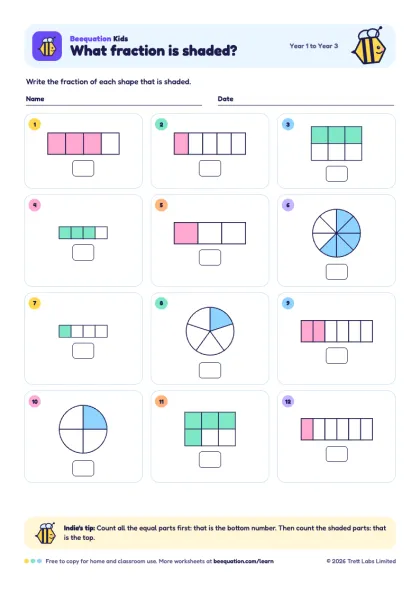 What fraction is shaded?Year 1, Year 2, Year 3 · Halves, thirds, quarters and moreDownload PDF
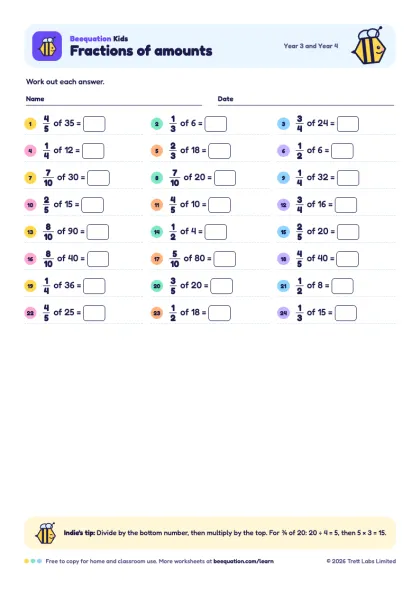 Fractions of amountsYear 3, Year 4 · Like ½ of 12 and ¾ of 20Download PDF
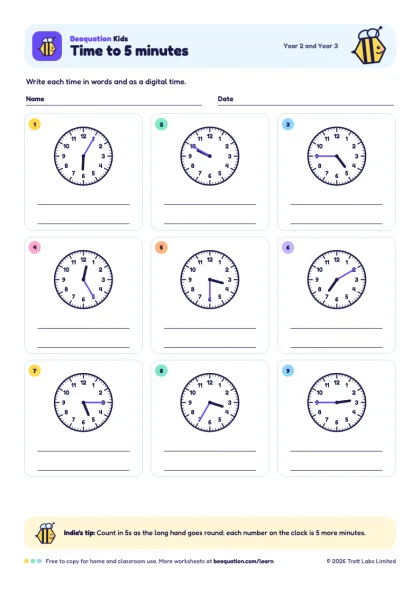 Time to 5 minutesYear 2, Year 3 · Read the clocksDownload PDF
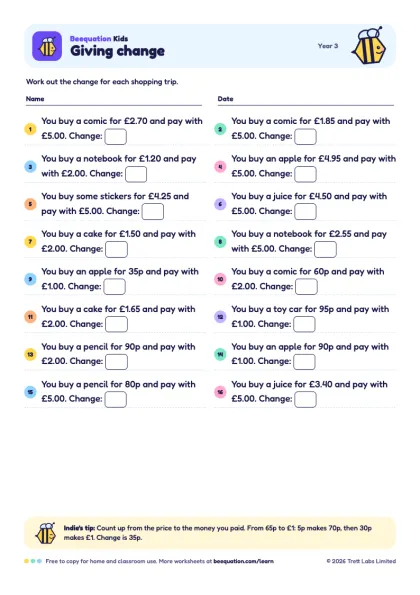 Giving changeYear 3 · Change from £1, £2 and £5Download PDF
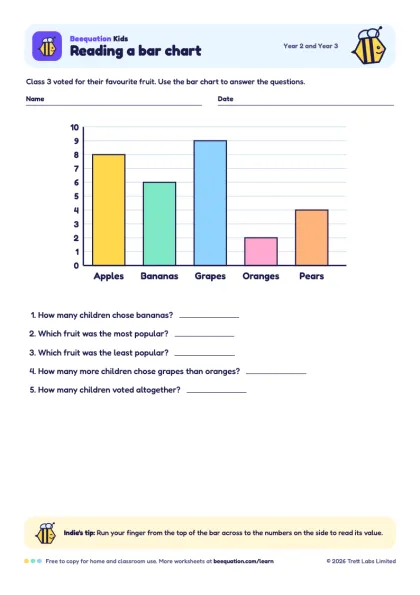 Reading a bar chartYear 2, Year 3 · Favourite fruit surveyDownload PDF
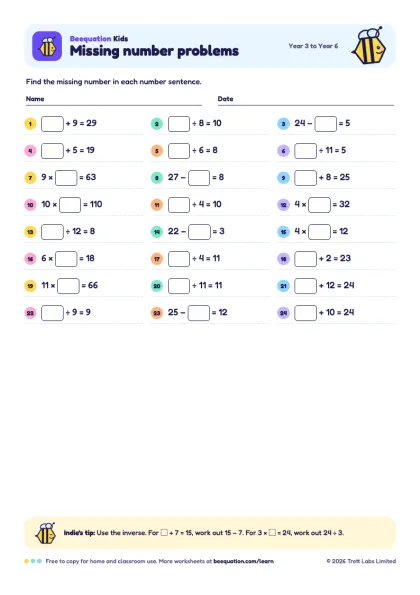 Missing number problemsYear 3, Year 4, Year 5, Year 6 · Find the number in the boxDownload PDF
Quick answers
The 3, 4 and 8 times tables, as well as keeping the 2, 5 and 10 times tables from Year 2 fresh. The rest, up to 12 × 12, come in Year 4.
A written way to add or subtract bigger numbers. You write them one above the other with the ones, tens and hundreds lined up, then work from right to left, exchanging when a column adds up to 10 or more (or when you need to take away more than you have).
So they can read clocks that use them. Year 3 children read I to XII on clock faces; in Year 4 they learn Roman numerals up to 100 (C), and in Year 5 up to 1,000 (M).
There are no national tests in Year 3. The next one is the Multiplication Tables Check in June of Year 4.
Practise with Indie
Beequation Kids turns number facts into honeycomb puzzles, with Indie giving a hint when a child is stuck. No ads and no data collected.