 Beequation

Learn › Topics › Algebra and ratio
Topic guide
Algebra and ratio
Algebra is maths with an unknown number in it. At primary school that starts as a box to fill in, 7 + □ = 10, and by Year 6 the box becomes a letter: n + 3 = 10. Algebra is also about spotting rules and patterns. Ratio and proportion are about comparing amounts and making things bigger or smaller in step, as in a recipe or a scale drawing.
Both get their own heading in the curriculum only in Year 6, but children work on the ideas from Year 1 onwards.
What children learn, year by year
This follows the National Curriculum in England (and the EYFS framework for Reception). US grades are roughly one year behind the UK year number.
| Year | What they learn |
|---|---|
| Reception | Copy, continue and make repeating patterns (red, blue, red, blue). Explore patterns in numbers to 10, such as odds and evens and doubles. |
| Year 1 | Missing-number problems with addition and subtraction, such as 7 = □ − 9. Count in 2s, 5s and 10s. |
| Year 2 | Use the link between adding and subtracting (the inverse) to find missing numbers: □ + 6 = 15. Count in steps of 2, 3 and 5. Make and continue patterns and sequences of shapes. |
| Year 3 | Missing-number problems with all four operations, such as □ × 4 = 32. Count in 4s, 8s, 50s and 100s. Scaling problems ("4 times as tall") and "how many combinations?" problems. |
| Year 4 | Count in 6s, 7s, 9s, 25s and 1000s, and backwards past zero into negative numbers. Harder scaling and combination problems. |
| Year 5 | Count forwards and backwards in steps of 10, 100, 1000 and more. Scale amounts by simple fractions, and solve simple rate problems ("3 pens cost 90p, so 1 pen costs 30p"). |
| Year 6 | Algebra: use simple formulas, describe number sequences, write missing-number problems with letters, find pairs of numbers that fit an equation with two unknowns. Ratio: compare the sizes of two amounts, sharing in a ratio, similar shapes and scale factors, percentages of amounts. |
The big ideas
1. The equals sign means "is the same as"
Many children read = as "and the answer is". That works for 3 + 5 = 8, then falls apart for 8 = 3 + 5 or 6 + □ = 4 + 5. Picture a balance: both sides must weigh the same. 4 + 5 is 9, so 6 + □ must also be 9, and the missing number is 3.
2. Undo it with the inverse
Adding and subtracting undo each other, and so do multiplying and dividing. That is the key to most missing-number problems. For □ − 9 = 7, ask "what number, take away 9, leaves 7?" and add the 9 back on: 7 + 9 = 16. For □ × 4 = 32, divide instead: 32 ÷ 4 = 8. Check by putting the answer back in: 16 − 9 = 7, and 8 × 4 = 32.
3. Sequences follow a rule
A sequence is a list of numbers (or shapes) that follows a rule. Younger children continue patterns and count in steps. Older children find and describe the rule. Sequences that go up or down by the same amount each time are called linear sequences. In Year 6 children may also spot a rule that jumps straight to any position: in 3, 7, 11, 15, 19 each number is 4 times its position, take away 1, so the 10th number is 4 × 10 − 1 = 39.
4. A letter stands for a number
In Year 6 the box becomes a letter. n + 5 = 12 means "some number add 5 makes 12", so n = 7. Writing 3a means 3 × a, so if 3a = 18 then a = 6. Some equations have more than one answer: for a + b = 10, a and b could be 1 and 9, 2 and 8, 3 and 7, and so on. Finding them all, in an organised list, is part of the Year 6 curriculum.
A formula is a rule for working something out, written with letters. The perimeter of a rectangle is 2 × (length + width), so a rectangle 7 cm long and 4 cm wide has a perimeter of 2 × (7 + 4) = 22 cm. Its area is length × width = 7 × 4 = 28 cm².
Say the equals sign out loud as "is the same as", and sometimes write sums the "wrong" way round: 10 = 4 + □. Children who only ever see the answer on the right can get stuck the first time it moves, and the habit takes a lot of undoing later.
5. Ratio compares parts, proportion compares with the whole
A necklace has 2 pink beads for every 3 blue beads. The ratio of pink to blue is 2 : 3 (said "2 to 3"). It compares one part with another part. The proportion of pink beads is ⅖, because 2 out of every 5 beads are pink. It compares a part with the whole. To share 20 beads in the ratio 2 : 3, a bar model helps: draw 5 equal boxes, put 20 ÷ 5 = 4 in each, so there are 8 pink beads and 12 blue ones. Check: 8 + 12 = 20.
6. Scaling multiplies everything by the same number
A scale factor says how many times bigger (or smaller) something gets. Enlarge a rectangle 2 cm by 5 cm by a scale factor of 3 and it becomes 6 cm by 15 cm. Every length is multiplied by 3. Recipes work the same way. Here are pancakes for 4 people scaled up for 6. Going through 2 people (halve, then multiply by 3) keeps the numbers friendly:
| Ingredient | For 4 people | For 2 people (÷ 2) | For 6 people (× 3) |
|---|---|---|---|
| Plain flour | 100 g | 50 g | 150 g |
| Eggs | 2 | 1 | 3 |
| Milk | 300 ml | 150 ml | 450 ml |
Common mistakes to look out for
- Treating = as "the answer is": for 4 + 5 = □ + 2, writing 9 in the box instead of 7.
- Using the wrong inverse: for □ − 9 = 7, working out 9 − 7 = 2 instead of 7 + 9 = 16.
- Reading 3a as "3 add a", or thinking a letter stands for an object ("a is for apples") rather than a number.
- Mixing up ratio and fraction: in a ratio of 2 : 3, the pink beads are ⅖ of the total, not ⅔.
- Adding instead of multiplying when scaling: turning a recipe for 4 into one for 6 by adding 2 of everything.
- Guessing a sequence rule from the first two numbers only: always check the rule works all the way along.
Five-minute algebra games for home
- Under the cup. Put 10 counters (or raisins) on the table, hide some under a cup, and ask how many are hidden. "I can see 6, so 4 are under the cup."
- Think of a number. "I think of a number, add 5 and get 12. What was my number?" Swap roles and let your child set the puzzles.
- Guess my rule. Your child says a number, you secretly double it and add 1, and say the answer: 3 gives 7, 5 gives 11. Who can work out the rule first?
- Pattern necklaces. Thread pasta or beads in a repeating pattern, then a growing one (1 red, 2 blue, 3 red...). What comes next? How many beads will the next group need?
- Squash and recipes. If the label says 1 part squash to 4 parts water, how much squash goes in a 500 ml jug? (5 parts, so 100 ml squash and 400 ml water.) When you bake, double or halve the recipe together.
Indie's challengeIndie builds a row of honeycomb cells from lolly sticks. Neighbouring cells share a side. 1 cell needs 6 sticks, 2 cells need 11 and 3 cells need 16. How many sticks does a row of 10 cells need? Show the answer
The first cell needs 6 sticks. Each new cell shares a side with the one before, so it needs 5 more. That makes 6 + 9 × 5 = 6 + 45 = 51 sticks. As a formula: sticks = 5 × cells + 1, and 5 × 10 + 1 = 51.
Free algebra and ratio worksheets
Print these for practice at home or in class. Each one has an answer sheet on the second page.
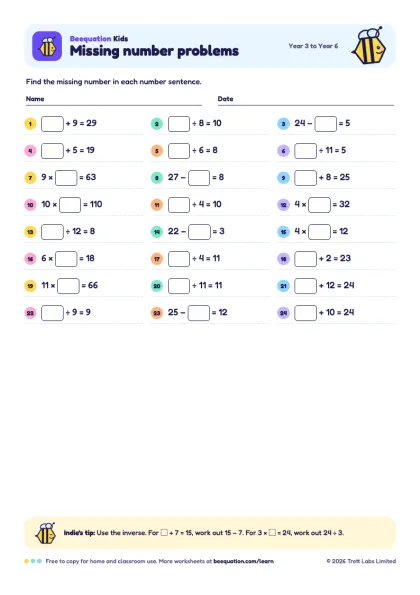 Missing number problemsYear 3, Year 4, Year 5, Year 6 · Find the number in the boxDownload PDF
Quick answers
Algebra has its own heading in the curriculum in Year 6 (age 10 to 11), but the thinking starts in Year 1 with missing-number problems like 7 + □ = 10.
A sequence that goes up or down by the same amount each time, such as 5, 8, 11, 14 (add 3) or 40, 35, 30, 25 (take away 5).
Ratio compares one part with another: 2 pink beads to 3 blue is 2 : 3. Proportion compares a part with the whole: 2 out of every 5 beads are pink, so ⅖ of the beads are pink.
How many times bigger or smaller a shape or amount becomes. With a scale factor of 2, every length doubles: a 3 cm side becomes 6 cm.
Practise with Indie
Beequation Kids turns number facts into honeycomb puzzles, with Indie giving a hint when a child is stuck. No ads and no data collected.